There’s an interval so dissonant that it’s earned the nickname ‘The Devil’s Interval’ and was avoided for centuries by composers and the pupils they taught.
Meet the tritone, and hear the story of the interval’s characteristics, history and dark associations.
What is a tritone?
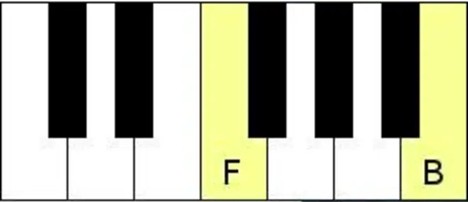
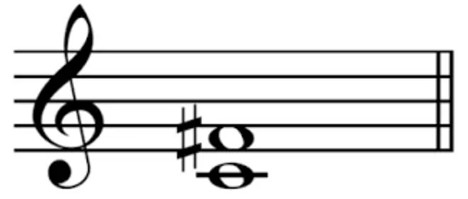
A tritone is an interval made up of three tones, or six semitones. In each diatonic scale (or the most basic scale of a key) there is only one tritone, and it occurs between the fourth and seventh degrees of the scale, so in a C major scale this would be between F and B. Or in G major it would be between C and F sharp:
Before the invention of keyboard instruments there was no ‘universal tuning’ and instruments were tuned in lots of different ways. The tritone actually played a vital role in the development of modern harmony… An interesting part of this story is that not all accidentals were created at the same time – F-sharp and B-flat were the first ones, and they were invented to try and solve the problem of the tritone in music.
The devil’s music
In times past, music was organized into modes rather than keys. The modes only used the white keys on a keyboard, so the only way you could play a different scale, or a different pattern of tones and semitones, was to start on a different note.
Each mode had its own recognizable flavor and character. There was an accepted tradition of which modes were suitable for joyful music (e.g. Ionian and Lydian) and which were for more mournful subjects, (e.g. Dorian and Phrygian).
The system of modes worked for every note of the scale… until you got to B. This scale was called the Locrian mode, and it was the only one where the fifth degree of the scale is not a perfect fifth – it’s an augmented fourth – or that forbidden tritone!
At times when music was holy, harmonious and ordered, this dissonant interval went against everything it appeared to stand for. It was christened diabolus in musica – the Devil in music and the Locrian mode was very rarely used.
Composers who wanted to use this last mode began to tamper with the devilish B to F interval to try and improve the scale. Some composers flattened the B until it was a perfect fifth below the F, and others sharpened the F until it was a perfect fifth above the B, giving us our first two accidentals – B flat and F sharp.
Why does the tritone sound so horrible?
John Sloboda, a professor of music psychology at the Guildhall School of Music and Drama, explained that the tritone is particularly unnerving because the human brain is hardwired to find harmony and symmetry in music:
“When we hear something dissonant, it gives you a little bit of an emotional frisson, because it’s strange and unexpected. The emotional result of hearing a tritone, might not be too different from the one experienced at the bottom of a staircase that failed to mention it’s missing its last step.”
Pitches sound harmonious together when there is a simple ratio between the frequencies of the two notes. The ratio of two notes an octave apart is a pleasing 2:1, and these sounds are so consonant we even give both the notes the same name. The next most consonant interval is the perfect fifth, (3:2). And so it continues, through the full range of intervals.
So how about our friend the tritone? Well, its notes end up in the unsightly proportion of 45:32 (or 64:45 depending on which way you tune it). Either way, this ratio sounds pretty ugly to the human ear.
But it’s not all bad news – the tritone has found great fame and fortune in the world of alarms and emergency sirens!
Was it actually banned by the church?
Rumours abound that music featuring the tritone was banned from churches because of its association with the devil. But as juicy as this gossip about the tritone might be, there is no evidence that this ever happened.
It’s more likely that the strict rules of harmony observed by those composing for the church forbade the use of the augmented fourth for musical reasons, rather than because they believed that it was the devil dwelling in music.
Where can I hear it?
The tritone, also known as the devil’s interval or diabolus in musica, is a dissonant musical interval spanning three whole tones, historically associated with tension, darkness, and the supernatural.
Classical and Musical Theater
- Camille Saint-Saëns, Danse Macabre: Uses the tritone to build a spooky, ghostly tension.
- Richard Wagner, Tristan und Isolde: Employs the interval to convey forbidden love and longing.
- Leonard Bernstein, West Side Story: Features prominently in the “Maria” chorus and the Jets’ motif to create conflict and unease.
- Claude Debussy, Prélude à l’après-midi d’un faune: Opens with a descending tritone in the flute solo to create an otherworldly atmosphere.
Rock, Metal, and Pop
- Black Sabbath, Black Sabbath: The iconic opening riff uses a tritone to establish the dark aesthetic of heavy metal.
- Jimi Hendrix, Purple Haze: The song begins with a sinister tritone between the guitar and bass.
- Metallica, Enter Sandman: The main riff relies on a tritone between the root note and the B♭ for its driving tension.
- Rush, YYZ: The opening bassline alternates between notes forming a tritone, mirroring Morse code.
- Marilyn Manson, The Beautiful People: The main guitar riff skips up and down a tritone from the root note.
- Slayer, Diabolus in Musica (Album): The entire album is named in homage to the interval, featuring it extensively.
Film, TV, and Other Media
- The Simpsons Theme (Danny Elfman): The very first vocal notes (“The Siiiiiimmmm-“) form a tritone.
- South Park Theme (Trey Parker/Marc Shaimon): The guitar riff is littered with tritones.
- Busta Rhymes, Woo-Hah!! Got You All In Check: Features a tritone-based bass sample.
- Nick Cave and the Bad Seeds, The Carny: Uses the interval to evoke a freaky, circus-like atmosphere.
Black Sabbath – “Black Sabbath” album: Black Sabbath 1970
The 1970 song “Black Sabbath” by the band Black Sabbath famously utilizes the tritone (also known as the augmented fourth or diminished fifth).
This dissonant musical interval, historically referred to as diabolus in musica or the “devil’s interval,” is the central element of the song’s opening riff. Guitarist Tony Iommi developed the riff after bassist Geezer Butler played a fragment of Gustav Holst’s orchestral suite The Planets, specifically the movement “Mars, the Bringer of War,” which prominently features the tritone. The use of this unstable, clashing interval helped define the dark, ominous sound of heavy metal.
Maria from Leonard Bernstein’s West Side Story
The song “Maria” from Leonard Bernstein’s West Side Story prominently features the tritone (also known as the augmented fourth or the “devil’s interval”).
- Musical Structure: The melody on the word “Maria” begins with a rising tritone between the first two syllables (“Ma” and “ri”), which then resolves upward to a perfect fifth.
- Symbolism: Bernstein used this dissonant interval throughout the score to represent tension, conflict, and the forbidden nature of the lovers’ relationship.
- Resolution: While the tritone creates immediate dissonance, its resolution to a consonant perfect fifth reflects the characters’ hope and the beauty they find in each other amidst the surrounding violence.
Jimi Hendrix’s Purple Haze
Jimi Hendrix’s “Purple Haze” prominently features the tritone, also known as the “devil’s interval” (or diabolus in musica).
- The Opening Riff: The song begins with a dissonant tritone played simultaneously by Hendrix’s guitar (playing B♭) and bassist Noel Redding (playing E), creating an immediate sense of tension and unease.
- Historical Context: This interval has been historically dubbed “the devil in music” due to its unsettling, clashing sound, which violates conventional harmonic expectations.
- Musical Impact: Hendrix’s use of this interval set an edgy, psychedelic tone that distinguished the track and influenced countless rock and metal musicians.