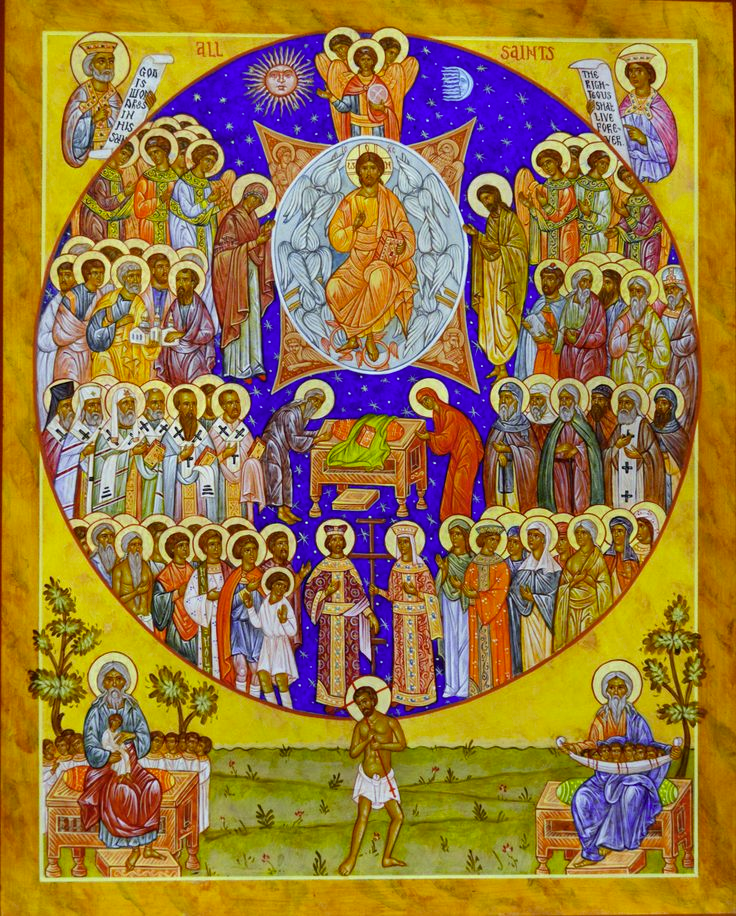
The impulse of Christians to express the communion of the living and the dead in the Body of Christ by a commemoration of those who, having professed faith in the living Christ in former days, had entered into the nearer presence of their Lord, and especially of those who had crowned their witness by giving up their lives for sake of the Gospel of Christ, goes back to the early days of the Christian Church. Gregory Thaumaturgus (the Wonder Worker), writing before the year 270, refers to the observance of a festival of all martyrs, though he does not give a date.
A century later, Ephrem the Deacon (†373) notes such an observance in Edessa on the thirteenth of May, and John Chrysostom, bishop of Constantinople (†407) writes that a festival of All Saints was observed on the first Sunday after Pentecost in Constantinople at the time of his episcopate, which remains the feast of All Saints in the Orthodox Churches to this day. In the West, a commemoration of All Saints became established with the rededication of the Pantheon at Rome—originally a pagan temple dedicated to “all the gods”—as a Christian church under the name Sancta Maria ad Martyres (Saint Mary and All Martyrs) by Pope Boniface the Fourth on the thirteenth of May in the year 610. In Ireland and England the focus of the day was slightly different.
Some manuscripts of the Martyrology of Oengus the Culdee (fl. early ninth century) note a commemoration of All Martyrs on the seventeenth of April and of All Saints of Europe on the twentieth of April. The metrical English calendar (tenth century, probably from Winchester) also includes the latter commemoration. However, from about the year 800 the first of November gained in popularity as a commemoration of All Saints. Alcuin (†804) mentions the date in a letter of that year, and manuscripts of the Martyrology of Bede have it as a marginal addition at about the same time. Arno, bishop of Salzburg (†821), had it adopted by a synod in the year 798.
The date of the first of November is probably based on the dedication of a chapel in Saint Peter’s, Rome, for the relics “of the holy apostles and of all saints, martyrs and confessors, of all the just made perfect who are at rest throughout the world” by Pope Gregory the Third (†741). A November commemoration of All Saints was already widespread in Frankish lands during Charlemagne’s reign (†814). Pope Gregory the Fourth, under Gallican influence, ordered the observance of the first of November as a feast of All Saints, and by the early ninth century an English calendar (of Oxford) ranks the day as a principal feast. There were over twelve hundred ancient church dedications to All Saints in England, a number surpassed only by dedications to Saint Mary the Virgin.
All Saints’ Day has been preserved in all editions of the Book of Common Prayer, from 1549 onwards. In the Book of Common Prayer (2019) of the Anglican Church in North America, All Saints’ Day is classed as a Principal Feast, along with Easter Day, Ascension, the Day of Pentecost, Trinity Sunday, Christmas Day, and the Epiphany; and alone of the seven, All Saints’ Day may be observed on the Sunday following, in addition to its observance on its fixed date. (In the Canadian parishes of the ACNA, when Remembrance Day observances fall on the first Sunday of November, All Saints’ Day may be observed on the preceding Sunday.) All Saints’ Day (or the Sunday following) is also recommended in the 2019 Prayer Book as being “the most appropriate days for Baptism,” along with the Easter Vigil, the Baptism of Our Lord, and Pentecost.
Prepared from Lesser Feasts and Fasts (1980), The Oxford Dictionary of Saints, and other sources
The Collect
Almighty God, you have knit together your elect in one communion and fellowship in the mystical body of your Son: Give us grace so to follow your blessed saints in all virtuous and godly living, that we may come to those ineffable joys that you have prepared for those who truly love you; through Jesus Christ our Lord, who with you and the Holy Spirit lives and reigns, one God, in glory everlasting. Amen.
The Lesson
Ecclesiasticus (Sirach) 44:1-14
Let us now praise famous men,
and our fathers in their generations.
The Lord apportioned to them[a] great glory,
his majesty from the beginning.
There were those who ruled in their kingdoms,
and were men renowned for their power,
giving counsel by their understanding,
and proclaiming prophecies;
leaders of the people in their deliberations
and in understanding of learning for the people,
wise in their words of instruction;
those who composed musical tunes,
and set forth verses in writing;
rich men furnished with resources,
living peaceably in their habitations—
all these were honored in their generations,
and were the glory of their times.
There are some of them who have left a name,
so that men declare their praise.
And there are some who have no memorial,
who have perished as though they had not lived;
they have become as though they had not been born,
and so have their children after them.
But these were men of mercy,
whose righteous deeds have not been forgotten;
their prosperity will remain with their descendants,
and their inheritance to their children’s children.[b]
Their descendants stand by the covenants;
their children also, for their sake.
Their posterity will continue for ever,
and their glory will not be blotted out.
Their bodies were buried in peace,
and their name lives to all generations.
OR Revelation 7:19-17
After this I looked, and behold, a great multitude that no one could number, from every nation, from all tribes and peoples and languages, standing before the throne and before the Lamb, clothed in white robes, with palm branches in their hands, and crying out with a loud voice, “Salvation belongs to our God who sits on the throne, and to the Lamb!” And all the angels were standing around the throne and around the elders and the four living creatures, and they fell on their faces before the throne and worshiped God, saying, “Amen! Blessing and glory and wisdom and thanksgiving and honor and power and might be to our God forever and ever! Amen.”
Then one of the elders addressed me, saying, “Who are these, clothed in white robes, and from where have they come?” I said to him, “Sir, you know.” And he said to me, “These are the ones coming out of the great tribulation. They have washed their robes and made them white in the blood of the Lamb.
“Therefore they are before the throne of God,
and serve him day and night in his temple;
and he who sits on the throne will shelter them with his presence.
They shall hunger no more, neither thirst anymore;
the sun shall not strike them,
nor any scorching heat.
For the Lamb in the midst of the throne will be their shepherd,
and he will guide them to springs of living water,
and God will wipe away every tear from their eyes.”
Psalm 149 Cantate Domino
Praise the Lord. O sing unto the Lord a new song; *
let the congregation of the faithful praise him.
Let Israel rejoice in the one who made him, *
and let the children of Zion be joyful in their King.
Let them praise his Name in the dance; *
let them sing praises unto him with timbrel and harp.
For the Lord has pleasure in his people *
and gives victory to those who are oppressed.
Let the faithful be joyful with glory; *
let them rejoice upon their beds.
Let the praises of God be in their mouth *
and a two-edged sword in their hands,
To inflict vengeance on the nations, *
and to rebuke the peoples,
To bind their kings in chains, *
and their nobles with links of iron,
That they may execute judgment upon them, as it is written; *
this is the honor of all his servants. Praise the Lord.
The Epistle
Ephesians 1:11-23
In him we have obtained an inheritance, having been predestined according to the purpose of him who works all things according to the counsel of his will, so that we who were the first to hope in Christ might be to the praise of his glory. In him you also, when you heard the word of truth, the gospel of your salvation, and believed in him, were sealed with the promised Holy Spirit, who is the guarantee of our inheritance until we acquire possession of it, to the praise of his glory.
For this reason, because I have heard of your faith in the Lord Jesus and your love toward all the saints, I do not cease to give thanks for you, remembering you in my prayers, that the God of our Lord Jesus Christ, the Father of glory, may give you the Spirit of wisdom and of revelation in the knowledge of him, having the eyes of your hearts enlightened, that you may know what is the hope to which he has called you, what are the riches of his glorious inheritance in the saints, and what is the immeasurable greatness of his power toward us who believe, according to the working of his great might that he worked in Christ when he raised him from the dead and seated him at his right hand in the heavenly places, far above all rule and authority and power and dominion, and above every name that is named, not only in this age but also in the one to come. And he put all things under his feet and gave him as head over all things to the church, which is his body, the fullness of him who fills all in all.
The Gospel
Matthew 5:1-12
Seeing the crowds, [Jesus] went up on the mountain, and when he sat down, his disciples came to him.
And he opened his mouth and taught them, saying:
“Blessed are the poor in spirit, for theirs is the kingdom of heaven.
“Blessed are those who mourn, for they shall be comforted.
“Blessed are the meek, for they shall inherit the earth.
“Blessed are those who hunger and thirst for righteousness, for they shall be satisfied.
“Blessed are the merciful, for they shall receive mercy.
“Blessed are the pure in heart, for they shall see God.
“Blessed are the peacemakers, for they shall be called sons of God.
“Blessed are those who are persecuted for righteousness’ sake, for theirs is the kingdom of heaven.
“Blessed are you when others revile you and persecute you and utter all kinds of evil against you falsely on my account. Rejoice and be glad, for your reward is great in heaven, for so they persecuted the prophets who were before you.