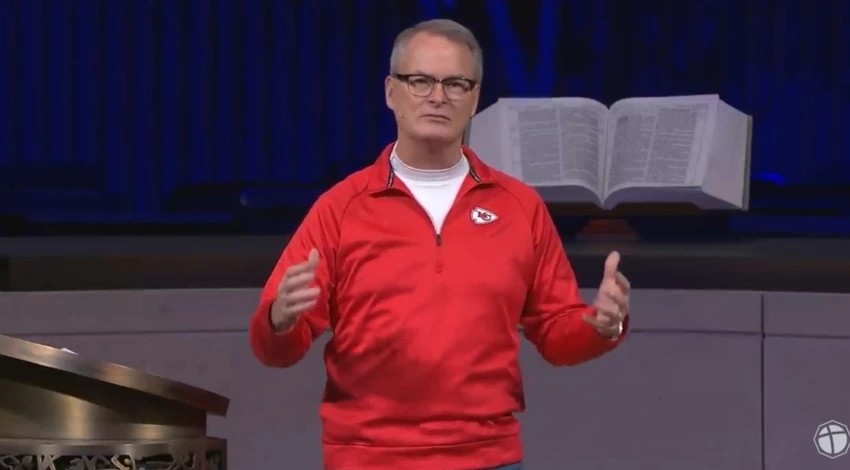
Rev. Adam Hamilton, a 62-year-old senior pastor of the multi-campus United Methodist Church of the Resurrection in Leawood, won the Kansas Democratic Party nomination for the U.S. Senate on August 4. He is set to challenge Republican incumbent Sen. Roger Marshall in the November election.
In a resurfaced 2022 sermon titled “Who goes to Heaven? Who goes to Hell?”, Hamilton expressed his belief that people from various religions will inherit eternal life through God’s grace, even apart from explicitly knowing the saving work of Jesus. He argued that God can apply Christ’s sacrifice to individuals who love God and their neighbors, suggesting they will realize Jesus was who they were searching for upon reaching Heaven.
Hamilton’s remarks drew sharp criticism from figures such as U.S. Senator Ted Cruz, who labeled the sermon “heretical” on social media and argued that it directly contradicts biblical scripture like John 14:6. Meanwhile, Hamilton’s background includes graduating from Oral Roberts University, earning a Master of Divinity from Southern Methodist University, writing over 30 books, advocating for changes to the United Methodist Church’s stance on same-sex marriage, and serving on a faith-based advisory council during President Barack Obama’s administration.
Rev. Adam Hamilton is the founding senior pastor of the United Methodist Church of the Resurrection in Leawood, Kansas, which is the largest United Methodist congregation in the United States with approximately 24,000 members. A prolific author of over 30 books and a former presidential appointee, he has long advocated for LGBTQ inclusion within the denomination, supporting the “One Church Plan” to allow local churches to decide on same-sex weddings and clergy ordination.
In April 2026, Hamilton entered the U.S. Senate race in Kansas as a Democrat, challenging incumbent Republican Roger Marshall. Although he initially considered an independent bid, a listening tour led him to join the Democratic primary, where he focused on lowering costs and “restoring decency” to national discourse.
Hamilton won the Democratic primary on August 4, 2026, with nearly 35% of the vote, raising a record-setting $3.7 million for his campaign. He now advances to the general election, aiming to become Kansas’ first Democratic senator since 1932, while planning to remain senior pastor at Resurrection and potentially retire from his church role by 2030.
MASS EXODUS OF MEMBERSHIP IN THE UNITED METHODIST CHURCH
The United Methodist Church (UMC) is losing churches primarily due to a historic schism over LGBTQ+ inclusion, specifically regarding same-sex marriage and the ordination of LGBTQ+ clergy. Between 2019 and late 2023, more than 7,600 congregations (approximately 25% of U.S. churches) disaffiliated, driven by conservative factions opposing the denomination’s perceived failure to enforce bans on these practices or fearing future liberalization.

Theological and Policy Disputes The core conflict stems from deep divisions over human sexuality. Conservative churches left because they viewed the UMC as too lenient or feared the denomination would officially remove bans on gay clergy and same-sex weddings, which indeed occurred at the 2024 General Conference. Conversely, some progressive congregations have also departed or expressed dissatisfaction because the UMC historically maintained restrictive policies, though the vast majority of the exodus consists of traditionalist churches joining the newly formed Global Methodist Church (GMC) to maintain conservative doctrines.
Demographic and Structural Factors The exodus is heavily concentrated in the South and among white congregations, with departing churches being 97% white compared to the denomination’s overall 89% white membership; predominantly Black, Asian, and Hispanic churches largely chose to remain. Beyond theology, some churches cited desires for local autonomy, resistance to denominational hierarchy, and disagreements over financial apportionments as motivating factors for leaving. This mass departure has resulted in the loss of over 1 million members in a single day in some reports, fundamentally altering the UMC’s size and influence.