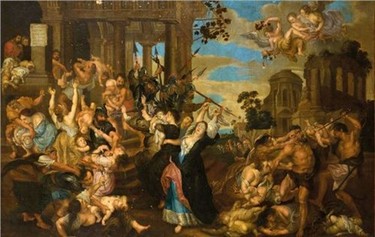
The Massacre of the Innocents is recounted exclusively in the Gospel of Matthew (2:16–18). According to the narrative, King Herod the Great, upon learning from the Magi of the birth of a newborn “king of the Jews” in Bethlehem, became fearful of a rival to his throne. After the Magi failed to return and report Jesus’ location—having been warned in a dream—Herod ordered the execution of all male children two years old and under in Bethlehem and its surrounding regions.
Matthew presents this event as a fulfillment of prophecy, citing Jeremiah 31:15: *”A voice is heard in Ramah, weeping and great mourning, Rachel weeping for her children and refusing to be comforted, because they are no more.”* This passage originally referred to the Babylonian exile, but Matthew reinterprets it typologically to connect the suffering of ancient Israel with the persecution surrounding Jesus’ birth.
Historicity and Scholarly Debate
Most modern scholars do not accept the historicity of the Massacre of the Innocents as a literal event. It is not mentioned in any non-biblical sources, including the detailed accounts of Herod’s reign by the Jewish historian Josephus, who documented many of Herod’s atrocities—including the execution of his own sons and wives.
Some scholars, such as James Dunn and Joan E. Taylor, argue that the story is plausible given Herod’s known cruelty and paranoia, making such an act consistent with his character. However, the lack of external corroboration leads many to view the account as theological rather than historical—a narrative crafted to emphasize the opposition Jesus faced from the beginning and to draw parallels with the Moses infancy narrative, where Pharaoh orders the killing of Hebrew boys (Exodus 1:15–16).
Estimates of the number of victims are low due to Bethlehem’s small size; scholars suggest between 6 and 20 children may have been involved, if the event occurred at all.
Theological and Symbolic Significance
Theologically, the Massacre of the Innocents underscores the spiritual conflict surrounding Christ’s arrival. It frames Jesus’ birth not in triumph alone, but in persecution and divine deliverance, foreshadowing His later suffering and crucifixion.
The slain children are regarded in Christian tradition as the first martyrs, innocent victims who died because of their proximity to Christ. The event is seen as a typological echo of Pharaoh’s infanticide, reinforcing the theme of God’s deliverance amid oppression.
Matthew’s use of Jeremiah’s lament also connects Jesus’ story to Israel’s broader redemptive history, positioning Him as the fulfillment of God’s salvific plan.
Commemoration and Cultural Impact
The Feast of the Holy Innocents is observed on 28 December in Western Christianity (Catholic, Anglican, Lutheran) and on 29 December in Eastern Orthodoxy. It is part of the Christmastide season and serves as a solemn reminder of the cost of Christ’s coming.
The Coventry Carol, a 16th-century English lullaby, mourns the slain children with the haunting refrain: *”O, lullay, thou little tiny child, by, by and lully, lullay.”* It was originally performed in mystery plays depicting the Nativity.
Despite the likely small scale of the event, its emotional and symbolic weight has endured in Christian liturgy and ethics, often invoked in discussions about the protection of children and the abuse of power.
Artistic Depictions
The Massacre of the Innocents has been a powerful subject in Western art, inspiring works by Cornelis van Haarlem, Guido Reni, Peter Paul Rubens, and Nicolas Poussin. These depictions often emphasize chaos, violence, and maternal grief, drawing on classical motifs such as the Lapiths and Centaurs to convey heroic struggle.
Artists used the theme to comment on contemporary violence, such as the religious wars of the Reformation, with soldiers sometimes shown bearing Habsburg insignia.
Gerolamo Mocetto and the Boucicaut Master also rendered the scene in Renaissance and medieval manuscripts, highlighting Herod’s cold observation of the slaughter.