
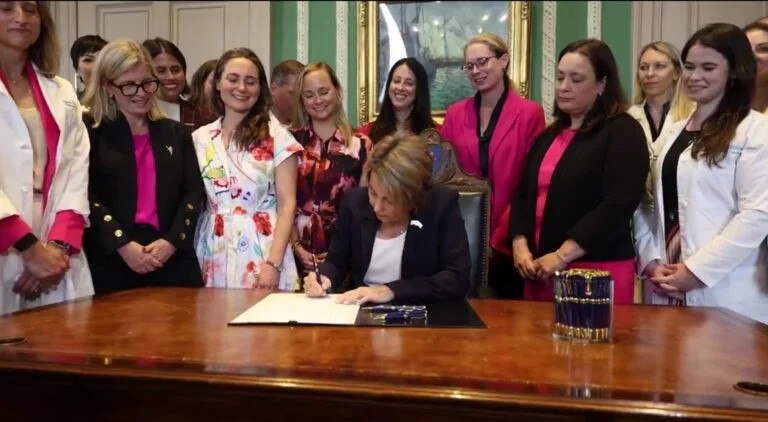
Governor Maura Healey signed legislation on August 10, 2026, removing Massachusetts’ 24-week gestational limit on abortion, making the state the 10th (or 11th, depending on counting D.C.) in the U.S. with no statutory cutoff. The new law, titled the Prioritizing Patient Access to Care Act (H.5595), allows abortions at any stage of pregnancy based on the professional judgment of a physician, replacing previous restrictions that permitted late-term procedures only in life-threatening situations or severe fetal anomalies.
The law aims to keep patients with serious pregnancy complications from needing to travel out of state for care and is set to take effect 90 days after signing. Healey framed the move as protecting reproductive freedom and trusting medical professionals over politicians, while opponents criticize it as allowing abortions “up to birth.”
- The bill passed the House 119–33, with all Republican representatives voting against it.
- It eliminates prior requirements that late-term abortions occur in hospitals.
- Supporters say fewer than 1% of abortions nationally occur after 24 weeks.
- The signing occurred during Healey’s reelection campaign, with abortion access positioned as a key issue.
- Prominent pro-life figures and organizations condemned the law as extreme and morally unacceptable.
I wonder how many democrats that vote for abortion has actually seen an abortion: I have a real life video provided here.
ROMAN CATHOLIC DOCTRINE
Maura Healey publicly identifies as a Roman Catholic. She was baptized in the Catholic Church and raised in an Irish-American Catholic household, frequently referencing her faith in public remarks to frame her views on social justice and caring for the vulnerable.
Faith and Public Policy Healey maintains that her support for abortion rights and LGBTQ+ equality does not detract from her Catholic identity, stating in a 2024 meeting with Pope Francis that these positions do not make her “any less of a Catholic.” However, her recent signing of legislation allowing abortion up to birth has sparked significant controversy, with some Catholic groups demanding she be denied Communion or formally excommunicated for acting against Church canon.
Church Relations Despite these conflicts, Healey continues to engage with Catholic institutions, having spoken at events for the Catholic Schools Foundation and visited St. John’s Preparatory High School in 2024. While Cardinal Seán O’Malley has collaborated with her on issues like immigration and affordable housing, other Catholic leaders have criticized her appearances at religious events as a “grave scandal” given her policy positions.
Statement from Catholicism.org:
The law is a brutal and barbarous measure, which will further expand child killing in a state whose abortion rate has already doubled in the last year.
This revised statute removes carefully prescribed language in the Massachusetts General Laws, detailing the exceptional circumstances under which abortions can be performed after the 24th week of pregnancy.
It replaces that specific language with the broad standard of “the professional judgment” of the attending physician, which means the decision to abort a fully formed, viable unborn child is entirely within the discretionary authority of the abortionist.
Massachusetts will now have one of the most permissive abortion regimes in North America, joining only nine other states and the District of Columbia in having no gestational limits on abortion.
Healey’s unsurprising decision to sign the measure into law reflects her continuing loyalty to her donor class in the abortion industry.
In 2015, following her first election to state-wide office, Healey credited Planned Parenthood for her victory, describing its endorsement as “a game changer for my campaign.”
The Planned Parenthood Advocacy Fund of Massachusetts went on to endorse Healey in the elections of 2018, 2022 and 2026.
DETAILS OF THE LAW
Under the new Massachusetts law signed by Maura Healey on August 10, 2026, a physician may perform an abortion at any point during pregnancy, including up to birth. The legislation removes the previous 24-week gestational limit and replaces specific statutory exceptions with a standard based solely on the professional judgment of the physician.
Key changes to the law include:
- Removal of Gestational Limits: The prior prohibition on abortions after 24 weeks, except for life-threatening situations or lethal fetal anomalies, has been eliminated.
- Physician Discretion: The decision to proceed with a late-term abortion now rests entirely on the doctor’s medical judgment in accordance with accepted standards of care, rather than a predefined list of qualifying conditions.
- Reduced Regulations: The law removes the requirement that abortions after 24 weeks must be performed in a hospital and eliminates mandatory yearly reporting for facilities.
The Prioritizing Patient Access to Care Act is scheduled to take effect in 90 days. Supporters state the change prevents patients from needing to travel out of state for complex medical care, while opponents argue it allows for elective abortions on healthy fetuses late in pregnancy.
ABORTION FACTS
ABORTION FACTS IN FLORIDA