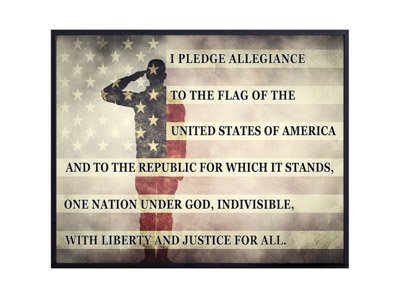
As Americans celebrate Flag Day and the 250th anniversary of the Declaration of Independence, historian William Federer emphasizes that the nation’s founding ideals remain inextricably linked to the belief that rights originate from God rather than government. In an interview with The Christian Post leading up to Flag Day—which commemorates the Continental Congress’s 1777 adoption of the official U.S. flag—Federer discussed how religious themes are deeply embedded in American history, including Cold War-era additions like “one nation under God” to the Pledge of Allegiance and “In God We Trust” to U.S. currency. He explained that these changes served to distinguish the United States and its doctrine of Creator-endowed rights from the atheistic communism of the Soviet Union. Highlighting a campaign spearheaded by the Knights of Columbus, Federer noted how Congress added the phrase to the pledge in 1954 under President Dwight Eisenhower to reinforce the spiritual foundations of the American political system.
To further illustrate this perspective, Federer referenced a 1979 U.S. Government Printing Office publication titled The Capitol — A Pictorial History of the Capitol and of the Congress, which asserts that faith in a sovereign God has been part of America’s public philosophy from its inception. The book notes that the nation’s story opens with the biblical premise of God, and it cites former Supreme Court Justice William Douglas’s observation that American institutions presuppose a divine being. Furthermore, the publication argues that only a nation founded on theistic presuppositions would implement a First Amendment ensuring religious freedom, maintaining that while the government remains neutral among denominations and avoids a state church, America and its governing institutions cannot remain neutral about God.
Reflecting on the symbolism of the U.S. flag alongside these Judeo-Christian roots, Federer recalled a Flag Day address delivered by President Franklin D. Roosevelt in 1942. In that speech, Roosevelt declared that the belief in man created free in the image of God represents the crucial difference between the United States and its adversaries, contrasting the freedoms of speech and religion against the oppression of Nazi and Japanese rule, and expressing faith that humanity would ultimately reject the oppressor’s sword. Concluding his remarks, Federer summarized Roosevelt’s historic words as a recognition of America’s global uniqueness, wherein government exists to secure Creator-given rights rather than act as a distributor of privileges doled out by dictators or socialist states.