
by Jenny Lynn Estes 2019 – Theophany Press / ISBN: 978-1733971027
The difference between Catholic and Anglican Rosaries is found in the number of beads and the form of prayers. While the Catholic Rosary is prayed with a focus on Mary for help in contemplating the mysteries of Jesus’ life; the Anglican Rosary relies on the Holy Spirit to guide and enhance times of prayer, worship, and encounter with Scripture.
The primary difference lies in structure and prayer tradition. The Roman Catholic rosary consists of 59 beads arranged in five decades of ten, with fixed prayers centered on the life of Jesus and Marian intercession. In contrast, the Anglican rosary (or prayer beads) has 33 beads arranged in four weeks of seven, separated by cruciform beads, and uses flexible prayers focused on scripture and contemplation without mandated Marian devotion.
Structural Differences
- Catholic: 59 beads total; five decades of ten beads, plus a short section leading to the cross.
- Anglican: 33 beads total; four groups of seven beads (“weeks”) separated by four larger “cruciform” beads, plus an invitatory bead and cross.
Prayer and Focus Differences
- Catholic: Uses a fixed set of prayers (Our Father, Hail Mary, Glory Be) and meditates on specific mysteries. It traditionally includes invoking Mary for intercession.
- Anglican: Has no prescribed prayers; users may use the Book of Common Prayer, the Jesus Prayer, or personal prayers. It generally avoids Marian intercession, focusing instead on direct prayer to God or meditation on the Holy Spirit.
Historical Context
- Catholic: A centuries-old tradition, popularized by the Dominican Order.
- Anglican: A modern innovation from the mid-1980s (developed by Rev. Lynn Bauman), blending elements of the Orthodox prayer rope and the Catholic rosary for Protestant contemplative practice.
The standard Anglican rosary (also known as Anglican prayer beads) features four cruciform beads, not five. These four beads are separated by four groups of seven smaller beads, called “weeks.” The total count of 33 beads (plus a cross) symbolizes the years of Jesus’ earthly life.
While the traditional configuration has four cruciforms, some practitioners or specific guides may suggest variations or additional beads for specific theological emphases, but the widely accepted and historical design consists of four cruciform beads.
ROMAN CATHOLIC ROSARY

Before we look at what makes Anglican rosaries unique, let’s take a quick look at the Roman Catholic style rosary.
The Roman Catholic rosary has a loop made up of five “decades” of ten beads separated by larger beads. In the example shown, the decade beads are tiger eye beads and the larger beads are matte black onyx. (Smaller tiger eye beads and metal beads act as separators in this case.)
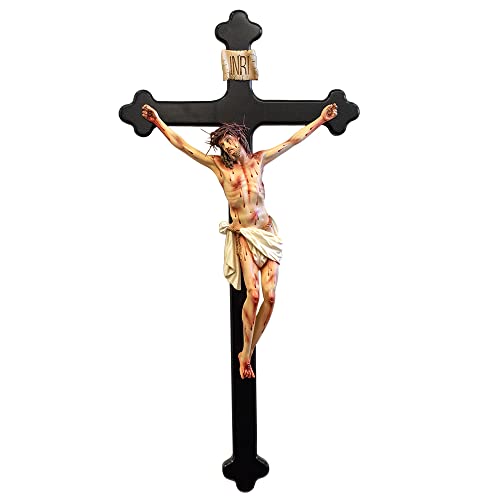
Notice that a Roman Catholic will always have a crucifix rather than a cross. In the Anglican tradition, we don’t display a cross with Christ.
The loop starts and ends at a connector, which is often a medal of some sort. (In this case, a Miraculous Medal.) A shorter string of three decade-size beads flanked on either end by larger beads leads to the crucifix from the connector.
There are prescribed prayers that are used for these different beads when praying the Roman Catholic rosary.
ANGLICAN ROSARY

The traditional style of an Anglican rosary is much smaller. It consists of four “weeks” of seven beads separated by larger beads known as cruciform beads. In the example shown, the week beads are tiger eye and the cruciform beads are matte black onyx. (Again, the smaller tiger eye and metal beads act as separators.)
The loop starts and ends at one of the cruciform beads and there is only one additional larger bead between the loop and the cross.
Whereas Roman Catholic rosaries traditionally use a crucifix as the cross, Anglican rosaries use a much wider variety of cross styles and sometimes even other religious symbols as the terminal end point. Celtic style crosses and other stylized crosses with Celtic knots, like the one shown, tend to be popular.
Anglican rosaries also differ from Roman Catholic rosaries in that there are no prescribed prayers to be used. There are a wide variety of prayers available to choose from, or you can create your own.
Find more information about using Anglican rosaries, including a variety of prayers to use with them, in our Anglican rosary resources.
ROMAN CATHOLIC CRUCIFIX
While many Anglicans do display crucifixes, particularly in High Church or Anglo-Catholic traditions, the preference for a plain cross in many Anglican parishes stems from historical and theological distinctions.
Historical Iconoclasm
During the English Reformation, particularly under Edward VI and Elizabeth I, there was a strong iconoclastic impulse to remove images deemed “popish” or idolatrous. Crucifixes were often destroyed or removed because they were associated with the Roman Catholic Church and the medieval cult of relics. This era established a tradition in many Anglican parishes, especially Low Church or Evangelical ones, of using only plain crosses or no crosses at all to distance the church from Roman practices.
Theological Emphasis on the Resurrection
Many Anglicans who prefer a plain cross do so to emphasize the Resurrection of Christ rather than his suffering. The empty cross is viewed as a symbol of victory, hope, and new life, reflecting the belief that Jesus is no longer on the cross but has risen. Some theological arguments suggest that a crucifix might distract from the risen Christ or incorrectly imply that Christ is still being sacrificed, whereas the plain cross highlights the completed work of salvation and the living Lord.
Diversity of Practice
It is important to note that there is no universal rule in Anglicanism regarding crosses. The Oxford Movement in the 19th century revived the use of crucifixes, vestments, and other liturgical elements in many Anglican churches. Consequently, Anglo-Catholic parishes frequently use crucifixes as aids to devotion and reminders of the Atonement, while Evangelical parishes may avoid them as unnecessary or potentially idolatrous. The choice often depends on the specific parish’s theological leaning within the broad Anglican tradition.
ANGLICAN PRAYERS
The Anglican rosary has one invitatory bead just above the cross. This is followed by four “weeks” of beads. A week is seven beads in sequence, and each week is separated by a cruciform bead. The four cruciform beads are called that because they form a cross.
The entire rosary has 33 beads, one for each year of Christ’s life. The prayers assigned to each bead are not as fixed as the prayers of the Catholic rosary. Some Anglicans use prayers from the Morning and Evening Prayers of the Book of Common Prayer. Others use the Jesus Prayer, the Kyrie, verses of the Bible or other traditional prayers of the church.
ROMAN CATHOLIC PRAYERS
The Catholic rosary begins with a recitation of the Apostle’s Creed, the Lord’s Prayer, three Hail Marys and the Gloria Patri, also known as “Glory be to the Father.” The two main prayers of the Catholic rosary are ancient. The Our Father, also called the Lord’s Prayer, dates back to the time of Jesus. Pieces of the Hail Mary are also biblical. The Catholic Encyclopedia traces the Hail Mary in its current form to roughly 1050 A.D.
This introduction is followed by five decades of the rosary. Each decade is ten beads separated by a single bead. Each of the ten beads counts a Hail Mary. The single bead marks an Our Father. Some Catholics add an “O, My Jesus” prayer and a Gloria Patri at the end of each decade. During the recitation of each decade, the person praying will also be meditating on one of the twenty mysteries. These mysteries are events from the life of Jesus. At the end of the rosary are two prayers: Hail, Holy Queen and O God, whose only begotten Son. The closing blessing is “In the Name of the Father. . .” and the sign of the cross.
Here is a great article from Anglican Compass that describes the form and function of the liturgy:
An excellent video from an Anglican Priest, Fr. Lee McLeod of St Aidans Anglican Church, Nicholasville, KY