
In a video posted Monday, August 31, pastor and theologian Dr. Gavin Ortlund addressed one of the longstanding points of division among Christians: whether believers should pray to those already in heaven and ask for their intercession. Ortlund, who serves as president of Truth Unites, a ministry devoted to theology, church history, and Christian apologetics, laid out the Protestant position and responded to the strongest objections raised against it.
Ortlund framed the discussion around a simple premise: the question is not what any individual believer prefers, but what God has revealed about how His people should pray. He argued that since Christianity is a revealed religion, believers have no authority to invent their own practices of prayer or spiritual life. On that basis, he concluded that Scripture nowhere instructs Christians to pray to or seek the intercession of saints, and that the only pattern it establishes is prayer directed to God alone.
He acknowledged that Christians should honor, love, and imitate the believers who came before them, and even granted that it is reasonable to think departed saints pray for those still living. What he disputed is the idea that living Christians should communicate with the departed and ask them to intercede. To support this, he pointed to the absence of any biblical example of it: major figures such as Abraham, Noah, and Moses never prayed to those who had gone before them, later prophets did not seek David’s intercession, the apostles did not appeal to Old Testament saints, and early church fathers such as Polycarp and Irenaeus did not invoke their predecessors either. Given how extensively Scripture addresses prayer, Ortlund argued, the total silence on this specific practice is significant.
Turning to church history, Ortlund noted that there is no clear evidence of Christians praying to saints during the first two centuries after the apostolic era. Prominent early writers who produced entire treatises on prayer, including Tertullian, Origen, and Cyprian, never mention the practice. According to Ortlund, it begins to appear only in scattered form in the late third century and does not become a widespread, mainstream feature of Christian devotional life until the fourth century, after which it continued to grow.
Ortlund also worked through several common objections. He argued that Revelation 5:8, often cited alongside Hebrews 12:1’s image of a “great cloud of witnesses,” describes the prayers of God’s people being presented in heaven but says nothing about believers invoking the saints directly. He drew a distinction between saints praying for the living and the living praying to saints, noting that these two ideas are frequently treated as equivalent when they are not. He raised a similar point about 2 Maccabees 15, a passage some traditions accept as canonical: even if the passage describes deceased figures praying for God’s people, it does not establish that living believers should call on saints for intercession.
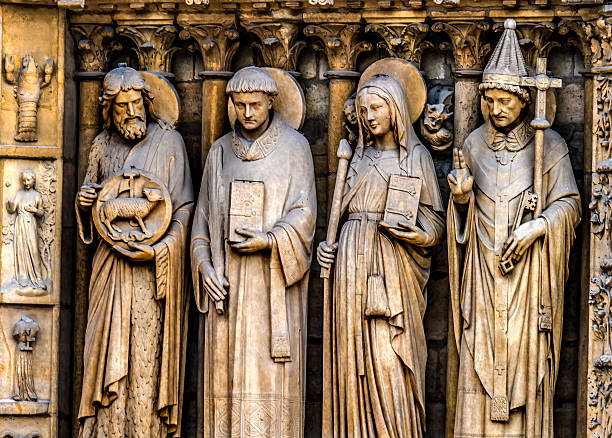
On the objection that Protestants unfairly dismiss church tradition, Ortlund clarified that his argument does not rest on the principle of sola scriptura but on the historical improbability that such a widespread practice would go completely undocumented for centuries if it had truly originated with the apostles.
Ortlund’s final and most extended argument addressed the comparison Christians often draw between asking a living friend to pray for them and asking a departed saint to do the same. He cautioned against assuming that communication with someone in heaven works the same way as communication with someone on earth, and argued that Scripture, not intuition, should govern how believers relate to those who have died. He also pointed to how the practice has actually played out historically, particularly in medieval prayers to Mary. In some of these prayers, Mary is asked to appease the wrath of God on believers’ behalf and is addressed with titles such as “fountain of salvation” and “mediatrix,” language Ortlund said effectively assigns her the intercessory work that belongs to Christ alone. He cited examples of medieval devotional texts, including a reworking of the Book of Psalms directed toward Mary rather than God, as evidence of how far the practice can drift from its original justification. Ortlund was careful to add that he was not claiming every Catholic or Orthodox Christian holds these views or that such prayers reflect official church teaching, but was making a historical observation about where the practice has sometimes led.
Ortlund closed by reaffirming that Christian practices that developed after the close of the biblical canon, however sincere or longstanding, must ultimately be tested against the authority of Scripture. He framed this as the heart of the Protestant concern: not that later church history is worthless, but that it holds a lesser authority than God’s revealed Word.
A ROMAN CATHOLIC RESPONSE