What the cover says
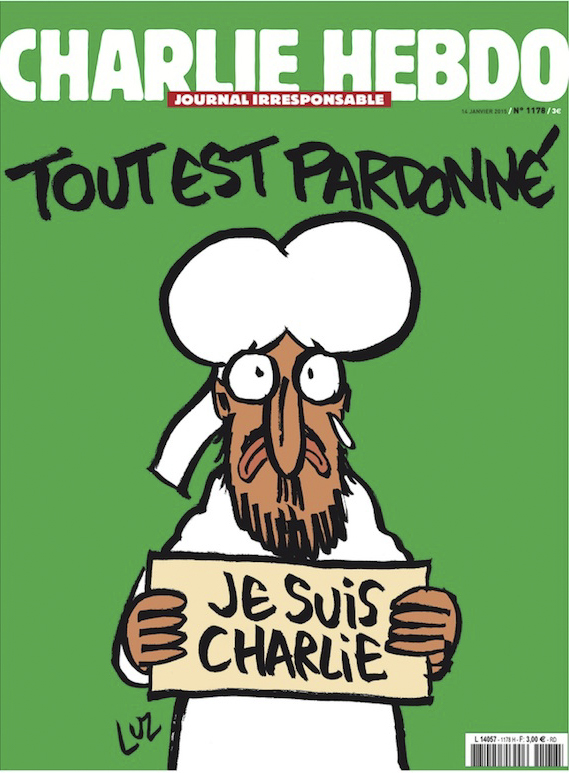
The large handwritten French phrase at the top is:
“TOUT EST PARDONNÉ”
“All is forgiven.”
The figure in the center is a caricature of the Islamic prophet Muhammad, drawn by Charlie Hebdo cartoonist Luz (Renald Luzier). He is crying a single tear and holding a sign reading:
“JE SUIS CHARLIE”
“I am Charlie.”
The smaller words at the top, “Journal irresponsable,” mean roughly “Irresponsible newspaper/journal,” a deliberately irreverent description consistent with the magazine’s identity.
The issue is dated 14 January 2015 and is numbered 1178.
Charlie Hebdo has published multiple controversial cartoons of the Prophet Muhammad, most notably sparking global outrage in 2006 by reprinting twelve caricatures originally published by the Danish newspaper Jyllands-Posten. The most infamous image from this series depicts the Prophet with a bomb-shaped turban, which critics argued branded all Muslims as terrorists, while another by cartoonist Cabu showed Muhammad weeping with the caption, “It’s so hard to be loved by idiots.”
Following the deadly January 2015 terrorist attack on the magazine’s offices, the publication featured a defiant cover titled “All is forgiven,” showing Muhammad holding a “Je suis Charlie” sign and shedding a tear. This image was drawn by staff cartoonist Luz and served as a message of forgiveness and solidarity with the victims.
In September 2020, to mark the start of the terror trial for the attackers’ alleged accomplices, Charlie Hebdo republished the original inflammatory cartoons, including the bomb-turban image, under the headline “All that for this.” The magazine’s director, Laurent “Riss” Sourisseau, stated that reprinting the caricatures was essential to demonstrate that they “will never lie down” and to uphold the freedom of satire.
THE ATTACK ON CHARLIE HEBDO OFFICES
On January 7, 2015, masked gunmen Chérif and Saïd Kouachi stormed the Paris offices of the satirical magazine Charlie Hebdo, killing 12 people in a terrorist attack motivated by the publication of cartoons depicting the Prophet Muhammad. The attackers, who identified themselves as members of Al-Qaeda in the Arabian Peninsula, opened fire on an editorial meeting and two police officers, then fled the scene before being killed in a shootout with police two days later.
The attacks were part of a broader three-day series of coordinated terrorist events in the Île-de-France region that resulted in a total of 17 deaths, including additional victims at a kosher supermarket and a police shooting in Montrouge. The incident sparked global outrage and a massive display of solidarity, most notably the “Je suis Charlie” movement and a historic march of 3.7 million people across France in January 2015.
In December 2020, a Paris court convicted 14 accomplices for their roles in supporting the attackers, including providing logistical aid and weapons, while the three gunmen—Chérif Kouachi, Saïd Kouachi, and Amedy Coulibaly—were killed during the police manhunt. The event remains a significant reference point for debates on freedom of expression, secularism, and the threat of homegrown militant Islam in Europe.
BACKGROUND
1. The background of Charlie Hebdo
To understand this particular cartoon, it helps to understand what Charlie Hebdo was before the terrorist attack.
The magazine grew out of the French satirical publication Hara-Kiri, founded in 1960 by François Cavanna and Georges Bernier. Its humor was deliberately vulgar, anti-authoritarian and provocative. It attacked politicians, the Catholic Church, the military, social conventions and virtually anyone else it considered deserving of ridicule.
In 1970, Hara-Kiri was banned after publishing an infamous joke about the death of former French president Charles de Gaulle. The staff responded by essentially changing the publication’s name to Charlie Hebdo. France’s Bibliothèque nationale de France records the transition as occurring in November 1970.
The important point is that Charlie Hebdo’s hostility toward religious and political authority long predated Islam-related controversies. Its basic philosophy was that almost nothing should be beyond satire.
2. Why Muhammad became particularly important to the magazine
The controversy surrounding Muhammad cartoons developed during the 2000s.
In 2005, the Danish newspaper Jyllands-Posten published a series of cartoons depicting Muhammad. The cartoons generated enormous controversy in Muslim-majority countries.
In 2006, Charlie Hebdo republished the Danish cartoons and added additional cartoons of its own. This brought the magazine into increasing conflict with Islamist extremists and generated death threats.
The issue was particularly sensitive because traditional Islamic understandings generally prohibit visual representations of Muhammad, especially when they are perceived as disrespectful. The precise theological and historical attitudes toward images vary among Muslim traditions, however.
3. The 2011 firebombing
The conflict escalated dramatically in November 2011.
Charlie Hebdo announced an issue jokingly titled “Charia Hebdo” and portrayed Muhammad on the cover. Shortly afterward, the magazine’s Paris offices were firebombed.
Nobody was killed in that attack, but the building was destroyed. The magazine’s editors nevertheless continued publishing Muhammad cartoons.
This established the basic confrontation that would eventually culminate in January 2015:
Charlie Hebdo: satire and freedom of expression should have no sacred limits.
Its Islamist extremist enemies: depictions of Muhammad were considered an intolerable insult that justified retaliation.
That distinction is important: the controversy involved Islamist extremists, not Muslims generally. Millions of Muslims around the world did not support the violence.
4. January 7, 2015: the terrorist attack
One week before this cover appeared, on January 7, 2015, brothers Said and Chérif Kouachi, armed with assault rifles, entered the Charlie Hebdo offices during an editorial meeting.
They killed 12 people, including some of France’s best-known cartoonists and journalists.
Among those killed were:
- Editor and cartoonist Stéphane Charbonnier (“Charb”)
- Cartoonists Jean Cabut (“Cabu”)
- Georges Wolinski
- Bernard “Tignous” Verlhac
- Economist and writer Bernard Maris
- Several other staff members and police officers
The attackers claimed they were acting in retaliation for Charlie Hebdo’s depictions of Muhammad and declared allegiance to al-Qaeda.
The attack was therefore not simply an assault on a magazine. It became a much larger confrontation over terrorism, freedom of speech, secularism, religion and the limits of satire.
5. “Je suis Charlie”
Immediately after the attack, “Je suis Charlie” (“I am Charlie”) became an international slogan.
It expressed solidarity with the murdered journalists and cartoonists and, more broadly, opposition to terrorism and support for freedom of expression.
The slogan appeared:
- on signs
- on posters
- on social media
- at demonstrations
- on buildings
- in newspapers around the world
On January 11, four days after the attack, an enormous demonstration took place in Paris. Approximately 1.5 million people participated in the Paris march, with millions more taking part in demonstrations throughout France. World leaders also joined the march.
So when Muhammad holds the “Je suis Charlie” sign in your image, the cartoon is deliberately placing him on the side of the victims.
6. Why Muhammad is crying
This is probably the most important part of the cartoon.
Muhammad isn’t portrayed here as an angry or threatening figure.
He is crying.
The tear communicates grief over what happened.
Luz, the cartoonist who drew the cover, had survived the massacre partly because he was late arriving at the editorial meeting. He arrived roughly 30 minutes after the attack had begun.
He subsequently drew this cover.
That makes the cartoon deeply personal. It wasn’t simply an outside commentator making a joke about terrorism. It was produced by someone whose colleagues and friends had just been murdered.
7. What does “All is forgiven” mean?
This is where the cover is frequently misunderstood.
“Tout est pardonné” does not mean that Charlie Hebdo had decided its cartoons were wrong.
Rather, it was an extraordinarily provocative statement of forgiveness and reconciliation following the massacre.
A surviving Charlie Hebdo editor explained that the staff wanted to respond to the killings without allowing themselves to be consumed by hatred. The idea was essentially:
We have been attacked and our friends have been murdered, but we are not going to respond with hatred or abandon our principles.
The magazine’s surviving journalists described the cover as an attempt to forgive rather than perpetuate hatred.
There is also a clever reversal taking place.
The terrorists supposedly acted in Muhammad’s name.
But in the cartoon, Muhammad himself is saying “Je suis Charlie.”
In other words, the cartoonist takes Muhammad away from the terrorists and makes him a symbol of solidarity with the magazine.
8. Why this was so provocative
The cover simultaneously makes several statements:
To the terrorists:
You didn’t silence us. We’re publishing Muhammad again.
To the French public:
We understand your solidarity and share in the grief.
To Muslims:
We aren’t declaring war on Muslims; the cartoon is aimed at the extremists who committed the murders.
To the extremists claiming to act for Muhammad:
Muhammad himself is depicted standing with us, not with you.
To everyone:
We will continue to exercise the right to satire despite the threat of violence.
That’s why the image is considerably more complicated than simply “a cartoon mocking Muhammad.”
9. The enormous significance of this particular issue
The January 14 issue became a worldwide publishing phenomenon.
Before the attack, Charlie Hebdo normally sold roughly 60,000 copies per issue. Following the massacre, demand was extraordinary. The planned print run was initially around one million and ultimately expanded dramatically; the issue eventually sold millions of copies.
People lined up outside newsstands across France.
The cover was reproduced by newspapers throughout the world, although some publications declined to reproduce the Muhammad image because of concerns about religious offense or security.
Consequently, this particular cartoon became an international symbol of the debate over free speech and religious sensitivity.
10. One important distinction about the attack
It’s sometimes stated that “this cartoon caused the Charlie Hebdo attack.”
That’s not quite accurate.
This cartoon was created after the attack.
The January 7 terrorists were responding to Charlie Hebdo’s earlier cartoons and its broader history of satire concerning Islam and Muhammad. This January 14 cover was the magazine’s response to the massacre.
The chronology is:
2005 — Danish Muhammad cartoons published
↓
2006 — Charlie Hebdo republishes them and adds its own
↓
2011 — Charlie Hebdo offices firebombed after Muhammad satire
↓
2012 — Further Muhammad cartoons generate international controversy
↓
January 7, 2015 — Terrorists massacre 12 people at Charlie Hebdo
↓
January 11, 2015 — Huge “Je suis Charlie” solidarity demonstrations
↓
January 14, 2015 — This cover is published
↓
“Tout est pardonné” — “All is forgiven.”
That chronology is essential to understanding the image.
In short
The cover is simultaneously a memorial, a statement of forgiveness, a declaration of defiance and a defense of free expression.
Its central irony is powerful: Muhammad, the figure whose depiction had been used by extremists as the justification for attacking Charlie Hebdo, is now depicted crying and declaring, “I am Charlie.”
That is why this particular cover became one of the defining images of the post-2015 debate over Islam, terrorism, secularism, blasphemy, freedom of expression and the role of satire in a democratic society.