
Stations of the Cross
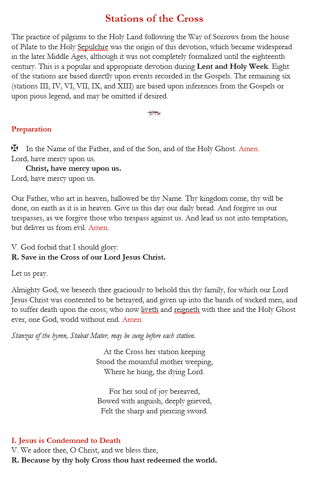
The practice of pilgrims to the Holy Land following the Way of Sorrows from the house of Pilate to the Holy Sepulchre was the origin of this devotion, which became widespread in the later Middle Ages, although it was not completely formalized until the eighteenth century. This is a popular and appropriate devotion during Lent and Holy Week. Eight of the stations are based directly upon events recorded in the Gospels. The remaining six (stations III, IV, VI, VII, IX, and XIII) are based upon inferences from the Gospels or upon pious legend, and may be omitted if desired.
The Anglican Service Book is an unofficial Anglican prayer book published in the United States in 1991. It is designed primarily for Anglo-Catholic parishes and provides a compilation of liturgical materials in traditional Elizabethan language (such as “thee,” “thou,” and “hath”).
The book is built around the structure of the 1979 Book of Common Prayer of the Episcopal Church but fills gaps where the 1979 version only offered modern English. Key characteristics include:
Publication: It was compiled by a committee of priests and published under the rectorship of David Moyer at the Church of the Good Shepherd in Rosemont, Pennsylvania. It has gone through multiple printings, with the fourth occurring in 2007.
Traditional Language Adaptation: It renders services like baptism, marriage, and burial into traditional language, which were only available in modern idiom in the 1979 BCP.
Sources: It compiles material from the Anglican Missal, Sarum Missal, Book of Occasional Services, and Saint Augustine’s Prayer Book.
Content: It includes all Rite I services and adds supplementary rites, offices, and ceremonies (such as the Asperges, Benediction of the Blessed Sacrament, and Walsingham Blessing) primarily of interest to traditionalist worshipers.