
How do you demand more pay for a position that does not exist… for a woman?
As the United Methodist Church marks its 70th year since approving the ordination of women in 1956, female ministers over the past decade have increasingly questioned if they are receiving fair pay and sufficient assignments to higher-paying roles. In response to these concerns, the Commission on the Status and Role of Women tracked local data and presented its findings at the North Alabama Conference’s recent annual meeting at Asbury United Methodist Church in Birmingham. The Rev. Christy Noren-Hentz announced that the conference has successfully reached parity for 2026 appointments, though she emphasized that continuing to prioritize appointment parity is vital for lifting up female clergy.
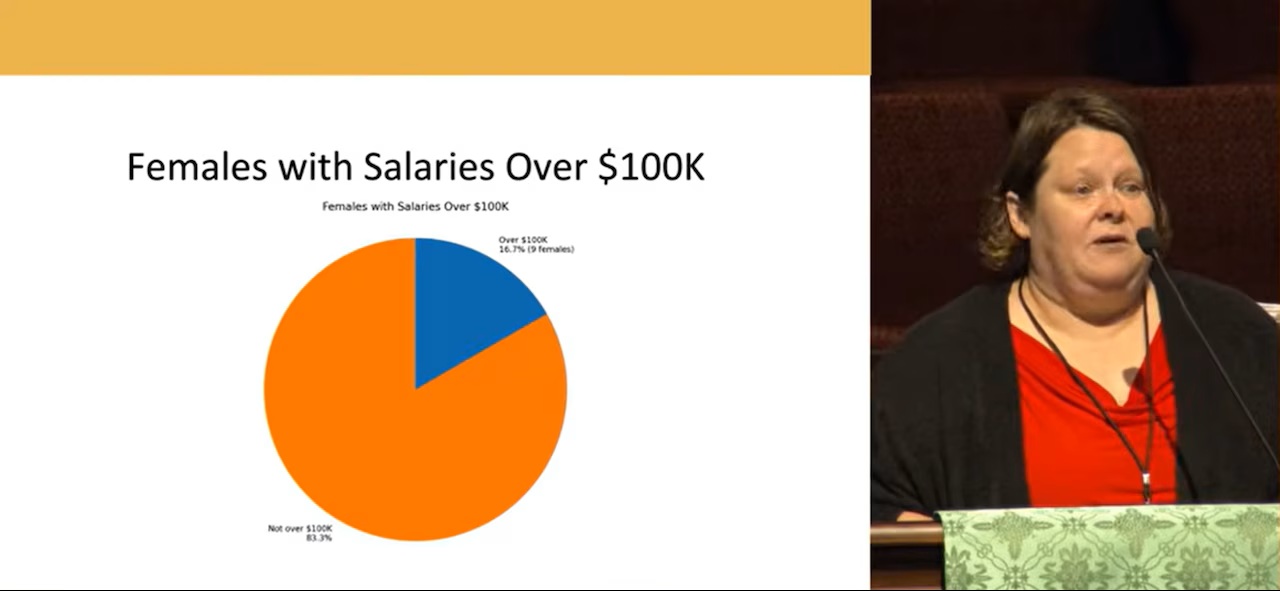
The conference consists of 165 total clergy members, made up of 111 men and 54 women. While top-tier positions—such as conference administrators, district superintendents, and pastors of large churches—can command salaries between $100,000 and $130,000, a disparity remains at this level; 23 percent of male ministers (26 men) earn over $100,000 compared to 16.7 percent of female ministers (9 women). However, the report considers the mid-tier salary range of $70,000 to $100,000 to be in a state of parity, encompassing 46 percent of male ministers (52 men) and 42.6 percent of female ministers (23 women). The remaining clergy members earn under $70,000 but make at least the minimum full-time pastor salary of roughly $38,000, which is supplemented by the conference’s equitable compensation plan if a local church cannot meet the requirement on its own.