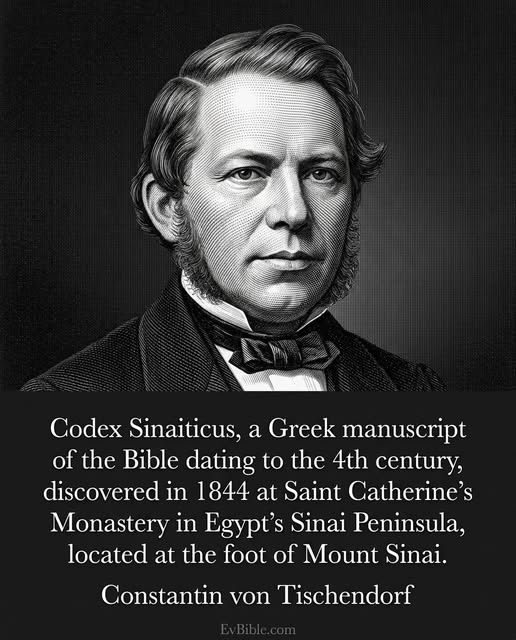
In 1844, German biblical scholar Constantin von Tischendorf traveled to the remote St. Catherine’s Monastery at the foot of Mount Sinai, where his obsessive hunt for ancient manuscripts took a dramatic turn.
While visiting the monastery’s library, he noticed a large basket filled with old parchment fragments that a librarian casually mentioned were destined to be burned as fuel, just as two basketfuls had been before.
Upon inspecting the leaves, Tischendorf recognized them as incredibly ancient Greek text from the Old Testament; he managed to save 43 leaves, but his obvious excitement made the monks defensive, locking away the rest.
It wasn’t until his third visit in 1859, backed by the patronage of the Russian Tsar, that a monk casually wrapped a bundle in a red cloth and showed it to Tischendorf in his cell—revealing not just the remaining Old Testament pages, but a complete 4th-century New Testament.
Tischendorf spent the entire night in his room copying the text by the dim light of a candle, knowing he had just laid eyes on one of the greatest biblical discoveries in human history: the Codex Sinaiticus. Codex Sinaiticus and Vaticanus are the two most influential sources for the New Testament.