The word creed comes from the Latin credo, meaning “I believe.” Clearly stating “what I believe” about anything is always difficult, yet in the 4th century the Church came together to do exactly that for all of Christianity. They produced a statement—a single paragraph—that articulated the essential beliefs of the Christian faith. What they produced was the Creed, the Symbol of Faith. Historically, a Christian has been defined as someone who believes this Creed. Over the centuries, various Christians have written other creeds—many of them excellent—but in the Eastern Orthodox Church we still hold to this one. We call it the Creed, and we recite it in our morning and evening prayers and at every Divine Liturgy throughout the year.
Once again, this YouTube channel is not a place to learn everything about Orthodoxy or the Early Church. It is meant to introduce elements of Orthodoxy and early Christian teaching. If you want to learn more about the Early Church, the Nicene Creed, or anything mentioned today, please visit an Orthodox Church and speak with a priest.
First, a bit of historical context from the era in which the Creed was written. Christianity had only recently been legalized, and that legalization was quickly followed by a bloody civil war. When the war ended, Emperor Constantine emerged victorious. He was not yet officially a Christian, but he was sympathetic to Christianity and admired it. However, he noticed that Christians, now free to speak openly, were arguing about several important doctrines. Recognizing that peace in his empire required harmony among its believers, Constantine consulted a Spanish bishop, Hosius of Cordoba, and asked him what was happening. Hosius explained that a major heresy was causing turmoil—Arianism—and that the only way to resolve it was to gather the entire Church into a council.
Arianism, as we’ve discussed before on this channel, was a recurring problem in the early centuries. In the interest of peace, Constantine sent invitations across the Christian world, calling for representatives to gather in the city of Nicaea to address the Arian controversy and to hold an ecumenical council.
The word ecumenical is today associated with the Church, but historically it meant “throughout the inhabited world.” Although this was a meeting of Christian bishops, they were gathering for the benefit of everyone. The council’s purpose was universal—it aimed to articulate the truth clearly for the whole world. The travel expenses of bishops from across the Christian world were paid out of the imperial treasury, and representatives came together in a rare and momentous assembly.
The Council of Nicaea is often called the “First Ecumenical Council,” though technically the first was the Apostolic Council recorded in the Book of Acts. That earlier council, however, was limited to the apostles in Jerusalem. Nicaea was the first time in nearly three centuries that the entire Church was represented in one place. In May or June of the year 325, 318 bishops gathered in Nicaea. Each bishop had exactly one vote. The number 318 was not overlooked—it matched the number of trained men in Abraham’s first army, and symbolically this gathering was seen as a spiritual army waging war against darkness.
Among the attendees were several figures who would become major saints, including a young deacon from Alexandria named Athanasius, who would later compile the list of books recognized as the Christian New Testament. Emperor Constantine welcomed the delegates and was present during the proceedings. His presence has led many modern historians to unfairly blame him for a wide array of things he never did. We can address those misunderstandings another time. For now, it’s enough to say that although he was present, he was not permitted to vote.
Why was a council suddenly necessary? Why did Christians suddenly need a creed? Because Christianity had been legalized. It had entered the public forum. Anyone could speak about it; anyone could voice an opinion; everyone could listen. This openness, while a blessing, also led to confusion and error. The Church now needed a unified and authoritative way to clearly articulate the truth of God.
The Nicene Council addressed several issues, including practical matters of Church governance. One notable example was the adoption of a uniform method for calculating Easter, or Pascha. But the council’s greatest achievement was the creation of a single paragraph—based on ancient baptismal confessions—that expressed the essential truths of Christianity. It was short, memorable, and clear. This work was so monumental that the resulting Creed still bears the council’s name.
More accurately, it is called the Nicene–Constantinopolitan Creed, because although it was accepted and used after Nicaea, the heresy of Arianism did not disappear. Decades later, during the reign of Emperor Theodosius, bishops again gathered—this time in Constantinople—and affirmed the Creed, expanding it slightly to clarify the Church’s teaching about the Holy Trinity. This is the form of the Creed recited today. In the Eastern Orthodox Church, we recite it exactly as it was finalized at the Council of Constantinople, and it has remained unchanged for over fifteen centuries.
This may sound technical or formal. Meetings, committees, and councils are not places we normally associate with deep spiritual experience. But it is important not to overlook how profoundly Christ-centered this event was. The bishops who gathered were not mere administrators. They were pastors representing their flocks. They cared deeply that the entire world be taught the truth about Christ. This council arose from love, faith, and devotion.
To quote St. Athanasius, who was present at the council:
“The faith confessed by the fathers according to the Divine Scriptures is enough by itself to overthrow all impiety and to establish belief in Christ.”
And elsewhere:
“The word of the Lord which came through the ecumenical synod at Nicaea abides forever.”
These were men who knew the Scriptures, knew Christ, and came together in prayer to write the Creed. Every year, when we commemorate the First Ecumenical Council, we chant:
“You are most glorious, O Christ our God.
You have established the Holy Fathers as lights upon the earth.
Through them You have guided us to the true faith.
O greatly compassionate One, glory to You.”
St. Athanasius emphasized that the council did not invent anything new. Rather, it reaffirmed the ancient faith against a new error. As he wrote:
“The ecumenical council committed to writing what those who were eyewitnesses and ministers of the Word have handed down to us from the beginning.”
The word catholic here is important. Athanasius uses it in its original sense—as an adjective, not a denominational label. Today we often think of “Catholic” or “Orthodox” as titles for groups: Catholics follow the Pope of Rome; I am an Eastern Orthodox Christian. But historically these words were descriptions, not titles. Orthodox means “right belief.” Catholic is often translated “universal,” but its deeper meaning is “according to the whole”—truth for all ages and for all creation.
When the Nicene Council met, and for centuries afterward, there were not separate denominations. There was simply the Church, which was both catholic and orthodox. Thus the Creed’s phrase “one holy, catholic, and apostolic Church” means one unified, holy community set apart for the world and for every generation, whose leadership and teaching trace directly back to the apostles.
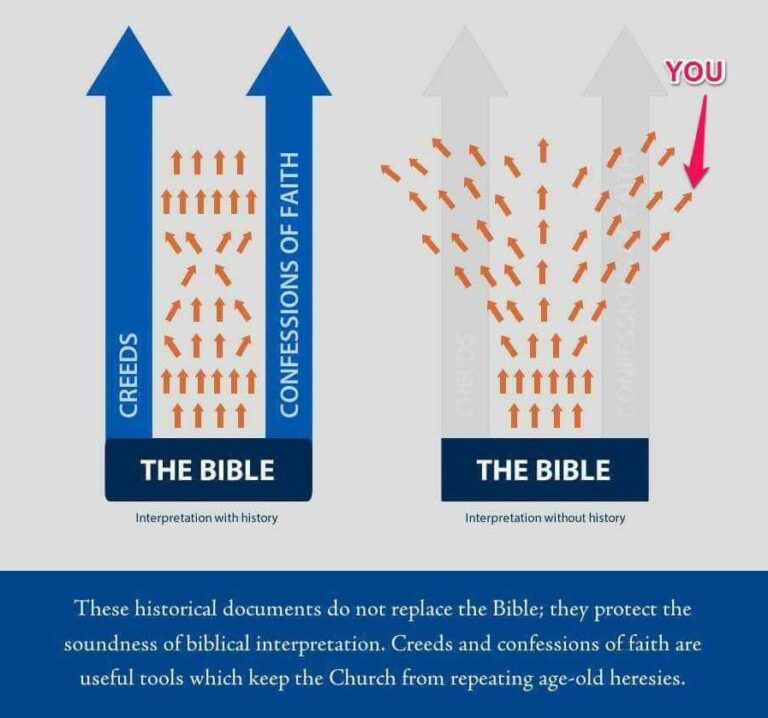
The Creed emphasizes the importance of being part of the Church of Christ. When we isolate ourselves—interpreting Scripture on our own, leaning on our own understanding—divisions arise, exactly as Scripture warns. It is essential to seek out and join the Church that Christ founded, the Church continued by the apostles, the Church that composed the Creed, the Church that exists today and will endure into eternity.
The Creed is structured into twelve articles that together explain who God is, what the Church is, and what the Church believes. These twelve points express our belief in the Holy Trinity. Interestingly, no major figures are mentioned by name except the Virgin Mary and, perhaps surprisingly, Pontius Pilate. Pilate’s name is included to mark a specific historical moment within the Creed’s theological confession. The message is clear: what we believe is both spiritually vital and historically verifiable.
Another interesting feature of the Creed is that although it is recited by the whole Church, it is spoken in the first-person singular: I believe. It is the defining statement of Christian faith, yet it is also deeply personal. The Creed is rooted in baptismal confessions—the statements made by believers preparing to be baptized. These were profoundly intimate, personal declarations of faith, and so the Creed continues to be recited in that same manner.
Finally, we must address a very significant controversy—too large to fully explain here. When I read the Creed in a moment, you will hear the words: “the Holy Spirit, the Giver of Life, Who proceeds from the Father.” This is the original and ancient wording. However, centuries after Nicaea, the Western Church added the phrase “and from the Son”—the Filioque, a small Latin addition with enormous theological and ecclesiastical consequences. For the Orthodox Church, this is not a minor issue; it remains one of the greatest points of division with Roman Catholicism, and with Protestants who use the Western version of the Creed. We are not resolving this thousand-year-old issue on the internet, much less in a YouTube comment section, so please avoid discussing the Filioque there. If you want to learn more, check the links in the description.
Remember that the Nicene Creed is much more than a doctrinal measuring stick. It is a beautiful, practical, memorable expression of our life in Christ—an essential part of Christian faith and devotion. If you want to learn more about Jesus, the Creed, the councils, the Church, and the ancient Christian faith, please visit an Orthodox Church and talk with a priest. You may feel familiar with Orthodoxy through videos or books—and that’s wonderful—but if you have never attended our services, you do not yet truly know us.
With all of that said, here is the Creed:
I believe in one God, Father Almighty, Maker of heaven and earth and of all things visible and invisible.
And in one Lord Jesus Christ, the Son of God, the Only-Begotten, begotten of the Father before all ages; Light from Light, true God from true God, begotten, not made; of one essence with the Father, by whom all things were made; who for us men and for our salvation came down from heaven, and was incarnate of the Holy Spirit and the Virgin Mary, and became man;
and was crucified for us under Pontius Pilate, and suffered and was buried; and on the third day He rose again, according to the Scriptures; and ascended into heaven and sits at the right hand of the Father; and He shall come again in glory to judge the living and the dead, whose kingdom shall have no end.
And in the Holy Spirit, the Lord, the Giver of Life, who proceeds from the Father, who with the Father and the Son together is worshiped and glorified, who spoke by the prophets.
In one Holy, Catholic, and Apostolic Church.
I acknowledge one baptism for the forgiveness of sins.
I look for the resurrection of the dead and the life of the world to come. Amen.