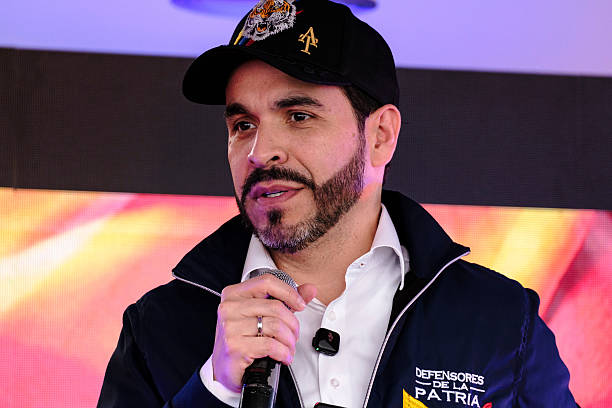
In a ceremony steeped in religious symbolism and historic firsts, Abelardo de la Espriella assumed the presidency of Colombia on Friday, August 7, 2026, in the southwestern city of Cali—the first time a Colombian presidential inauguration has been held outside the capital, Bogotá, in modern republican history. The event signaled not only a political shift from the left-wing administration of Gustavo Petro but also a profound cultural and spiritual reorientation, culminating in De la Espriella’s impassioned declaration: “Long live Christ the King!”
Arriving at the Arena USC auditorium of the Santiago de Cali University alongside his wife, Ana Lucía Pineda, their four children, and his incoming cabinet, the new president framed his mandate as a divine mission. To his left on stage stood the image of the Virgin of Fátima—a visual cue consistent with the openly Catholic identity of his administration, which includes Vice President José Manuel Restrepo and ambassador-designate to the OAS, Alejandro Ordóñez, both practicing Catholics.
Interfaith Participation and Vatican Presence
Though the ceremony was unmistakably Catholic in tone, it incorporated interfaith elements. Following the official swearing-in, a moment of interreligious praise began with the performance of “Aleluya” by Colombian singer Maía. The great rabbi David Michaan and Pastor Eduardo Cañas offered reflections, after which Father Rodolfo Londoño, the newly appointed chaplain of the Casa de Nariño, led a prayer to place the government “under the action of the Holy Spirit.”
Representing the Holy See was Mons. Dagoberto Campos, Apostolic Nuncio in Ecuador, as the Vatican’s new nuncio to Colombia had not yet been appointed following the March promotion of Mons. Paolo Rudelli within the Secretariat of State. Mons. Javier Múnera, president of the Episcopal Conference of Colombia, also attended, conveying the faithful’s hopes for unity, reconciliation, and a society where “no one feels excluded or discriminated against.”
“Thank You, Lord, for Blessing Colombia”
After the university ceremony, De la Espriella proceeded to the Pichincha Military Canton to deliver his first presidential address. He opened with a prayer of gratitude: “A feeling of deep gratitude to our Lord Jesus Christ for blessing Colombia and for never having turned his provident gaze away from this blessed land. Thank you, Lord.”
Beyond outlining new economic, security, and health policies, the president declared a “cultural battle” to restore foundational values: “the family, merit, discipline, respect for the law, love for the country, belief in God.” “I will not allow what has made our society great and strong for generations to continue to be ridiculed,” he asserted, positioning his administration against what he portrayed as the moral erosion under Petro.
He concluded by invoking divine guidance—“May God bless each of his children” and “illuminate our understanding”—before rallying the crowd with his campaign slogan: “Everything for the country, compatriots, everything for the country, nothing without it. Firm for the country! Long live Christ the King!” The event closed with a tribute to fallen soldiers and a prayer led by Mons. José Roberto Ospina, Apostolic Administrator of the Military Bishopric.
Why Cali? Decentralization as Political Symbolism
Holding the inauguration in Cali was a deliberate break with tradition. De la Espriella had long argued that moving the ceremony outside Bogotá would signal a commitment to decentralization and regional inclusion. To operationalize this, his government will maintain alternate presidential headquarters in Cali and Barranquilla—his hometown—as well as an office in Medellín.
The logistical undertaking was substantial. Congress approved the venue change in late July, and the city deployed 11,000 members of the Public Force, armored vehicles, and restrictions on private vehicle circulation and alcohol sales until 8:00 p.m. to ensure security. International leaders, including Spain’s King Felipe VI and presidents from Argentina, Ecuador, and Chile, attended, underscoring the event’s diplomatic significance.
Political Absences and Electoral Context
Notably absent were lawmakers from the Historical Pact, the party of outgoing President Gustavo Petro, who has refused to recognize De la Espriella’s electoral victory, alleging—without evidence—fraud. De la Espriella won the June 21 runoff with 49.6% of the vote against Iván Cepeda’s 48.7%, a result certified by the National Electoral Council on June 24.
Inherited Challenges: Peace, Security, and Cultural Policy
De la Espriella inherits a nation grappling with escalating violence. According to the Ideas for Peace Foundation, members of armed groups grew from 15,120 in December 2022 to 28,802 by July 2026, following the collapse of Petro’s “Total Peace” initiative, which failed to secure any formal accords by the end of his term.
Culturally and legally, the new administration faces contentious policies enacted under Petro, including the extension of euthanasia to minors and people with mental illnesses, regulations facilitating gender transitions for minors, and Colombia’s withdrawal from the Geneva Consensus Declaration, which opposes classifying abortion as a human right. De la Espriella, who signed the “Commitment to Life and Family,” has pledged to reverse these measures as part of his broader moral and cultural renewal agenda.
With a mandate rooted in conservative values, religious conviction, and a promise of regional rebalancing, Abelardo de la Espriella’s presidency begins at a pivotal moment for Colombia—one defined by deep polarization, security challenges, and a fierce contest over the nation’s soul.