
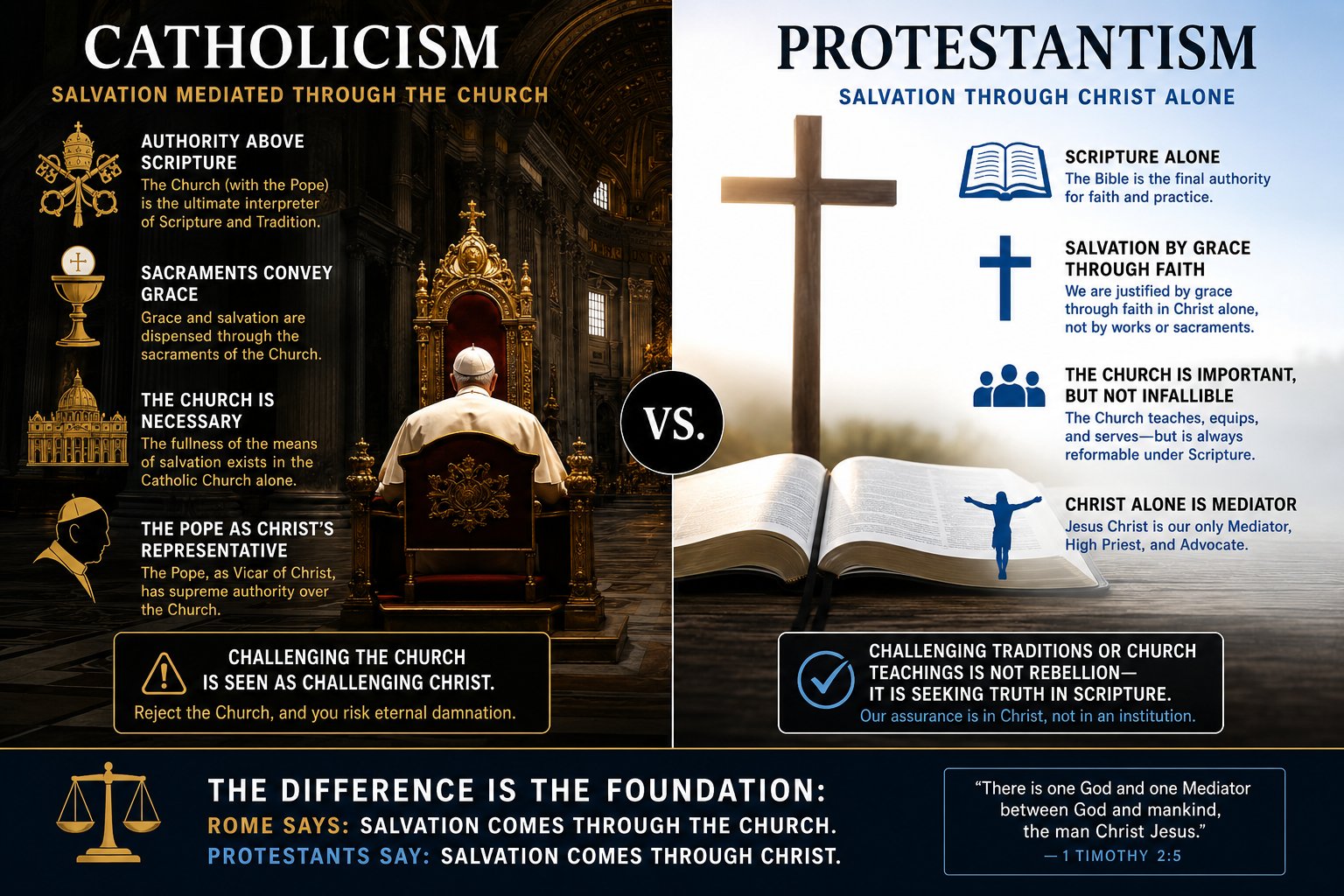
The Roman Catholic backlash to @gavinortlund and @WesleyLHuff has been revealing. Both men are careful and respectful in their critiques of Roman Catholic doctrine, yet both have faced deeply personal attacks. This raises an important question: why do measured criticisms of Rome often provoke such a strong reaction?
The answer lies in Rome’s own claims about itself. In Roman Catholic theology, the Church is not merely one tradition among many but the visible institution entrusted with the fullness of salvation, sacramental grace, and authoritative interpretation of Scripture and Tradition. As a result, criticism of Rome is often felt not simply as disagreement, but as an attack on the very structure through which Christ is believed to govern and save His people.
Protestantism, by contrast, does not ultimately ground salvation in institutional submission. Baptists, Presbyterians, and Lutherans may strongly defend their traditions, but their confidence rests finally in Christ’s finished work received by faith, not in the indefectibility of a particular hierarchy or institution.
That difference explains why historical criticism affects the two systems differently. Protestants can acknowledge complexity, disagreement, and reform within church history without feeling that Christianity itself collapses. Rome, however, must maintain continuity between present dogma and apostolic teaching. If history reveals ambiguity, contradiction, or doctrinal development where Rome claims unbroken continuity, then its authority claims are weakened.
For that reason, debates over church history are often about more than history itself. Protestants may see a discussion about doctrine or evidence, while many Catholics perceive a challenge to the very foundation of authority, certainty, and salvation. If Rome is wrong about its own claims, then the issue is not secondary—it calls into question the role Rome has placed between Christ and the believer.
BONUS:
This is the result of my research in Logos Bible Software. 300,000 books were part of an analysis on the context of 1 Timothy 2:5. I passage that all Roman Catholics have a problem with an d rarely speak about…
The statement in 1 Timothy 2:5 appears within a carefully structured passage about salvation (2:1–7) where the theme of universal redemption runs throughout, emphasizing that prayer should be offered for all people and that God desires everyone to be saved and come to know the truth.[1] This theological claim about God’s universal salvific will requires substantiation, which Paul provides through traditional material drawn from early Christian teaching.[1]
The affirmation of monotheism—“there is one God”—echoes the Shema (Deuteronomy 6:4) and substantiates the claim that God’s desire to save extends universally to all people.[1] In the context of the ancient world, this declaration offered comfort to those who had lived in constant fear of multiple deities, contrasting sharply with both Jewish and Greek thought, where various intermediaries were believed to connect people with the divine.[2] The theological distinctiveness of Christianity lies in offering “direct access” to the one God through Christ alone.[2]
The passage creates a striking paradox: while “one God” signals universal access to salvation, “one mediator” narrows that access to a single means.[1] Rather than suggesting equivalence with God, the emphasis falls on Jesus’ mediatorship rooted in his humanity, with the phrase “the man Christ Jesus” defining what mediator means.[1] The mediator concept may have been chosen to counter false teachers interested in the Old Testament law, allowing Paul to contrast Moses as mediator of the old covenant with Christ as mediator of the new covenant.[2]
The passage continues by noting that Christ “gave himself as a ransom for all,” describing his redemptive work as testimony given at the proper time. (1 Tim 2:1–6)
[1] Philip H. Towner, “Christology in the Letters to Timothy and Titus,” in Contours of Christology in the New Testament, ed. Richard N. Longenecker, McMaster New Testament Studies (Grand Rapids, MI; Cambridge, U.K.: William B. Eerdmans Publishing Company, 2005), 228–229.
[2] Douglas Mangum and E. Tod Twist, 1 Timothy, ed. Douglas Mangum and Derek R. Brown, Logos Research Commentaries (Bellingham, WA: Logos Bible Software, 2026). [See here, here, here.]


