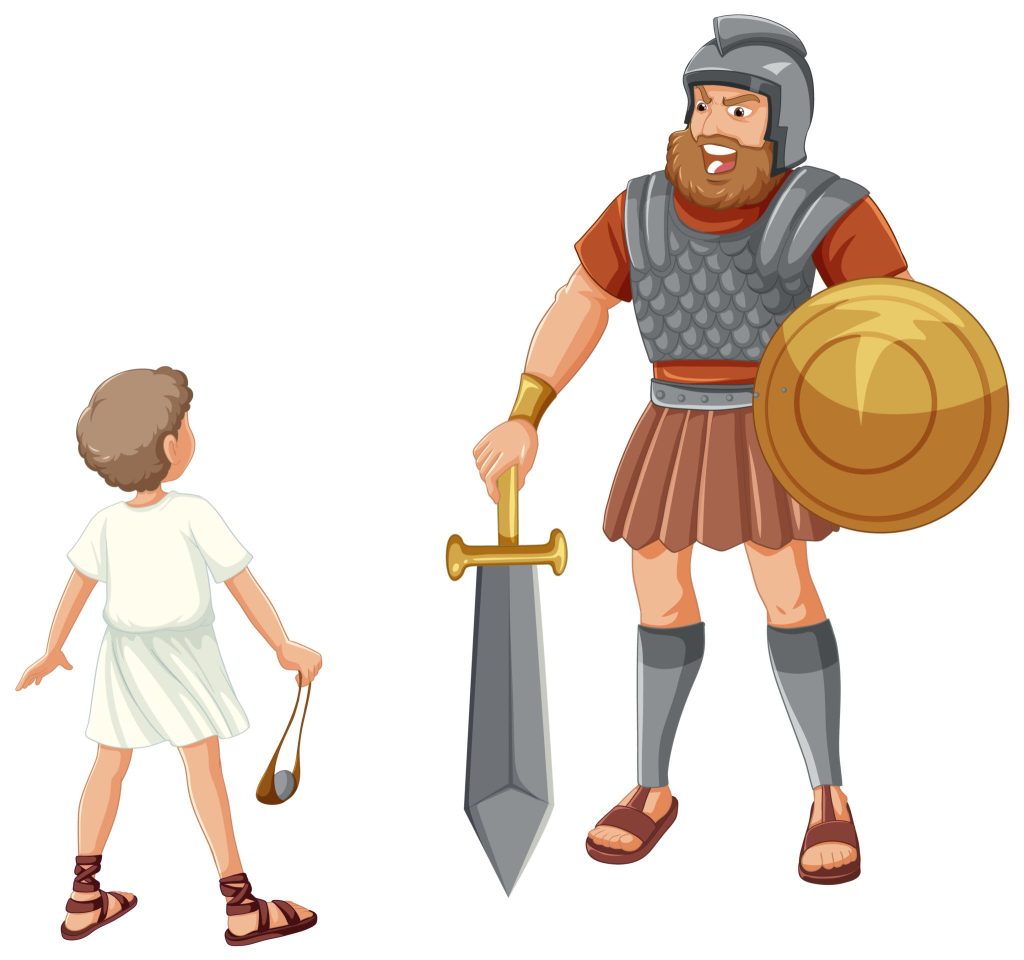
The famous biblical account of David and Goliath, recorded in 1 Samuel 17, stands as western culture’s ultimate archetype for an underdog overcoming insurmountable odds. While the narrative of a young shepherd boy defeating a mighty warrior with a single slingstone is universally recognized, historical, textual, and archaeological analyses reveal a complex debate regarding the physical stature of the Philistine champion. The core of the controversy centers on a stark discrepancy in ancient manuscripts: was Goliath a towering giant standing over nine feet tall, or was he a formidable but realistically sized warrior measuring closer to six feet, nine inches?
This discrepancies is vividly reflected in modern English Bible translations, which rely on different ancient manuscript traditions. For instance, the Christian Standard Bible (CSB) states that Goliath was “nine feet, nine inches tall,” aligning with the traditional Hebrew manuscript tradition. Conversely, the New English Translation (NET) states he was “close to seven feet tall,” electing to follow ancient Greek and alternative Hebrew variants.
The Textual Framework: Cubits and Spans
To understand how these translations arrived at such vastly different numbers, one must examine the ancient system of measurement used in the texts. The height of Goliath is measured in “cubits and a span.”
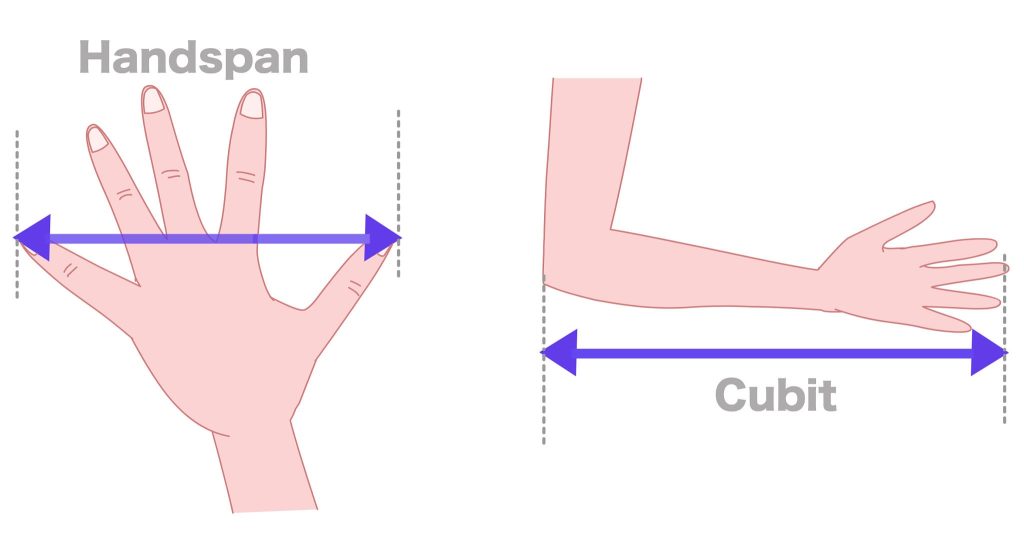
- Cubit: In the ancient Near East, a cubit was based on the distance from the elbow to the tip of the middle finger, averaging roughly 18 inches.
- Span: A span was half a cubit—the distance between the thumb and the pinky finger when the hand is fully splayed—averaging roughly 9 inches.
The textual divergence occurs between two primary ancient manuscript traditions:
| Manuscript Tradition | Stated Height | Modern Equivalent |
| Masoretic Text (MT) & Latin Vulgate | Six cubits and a span | ~9 feet, 9 inches |
| Septuagint (LXX) & Dead Sea Scrolls ($4QSam^a$) | Four cubits and a span | ~6 feet, 9 inches |
This difference accounts for a massive 36-inch (three-foot) discrepancy in the physical description of the Philistine champion.
Analyzing the External Evidence
Evaluating the manuscript evidence requires looking at the historical witnesses that support each reading. The shorter height of four cubits and a span boasts significant, early historical backing. It is found in the Septuagint (the ancient Greek translation of the Hebrew Bible dating to the 3rd–2nd centuries BCE) and is explicitly echoed by the first-century Jewish historian Flavius Josephus in his work Antiquities of the Jews.
Furthermore, discovery of the Dead Sea Scrolls at Qumran provided a Hebrew witness to this shorter height in a fragmentary scroll designated as $4QSam^a$. Because the Dead Sea Scrolls predate the standardized Masoretic Text by centuries, many textual critics argue that the shorter height represents the original reading.
However, textual scholars caution against treating $4QSam^a$ as an infallible witness. The scroll is highly fragmentary; in the specific section of 1 Samuel 17:1-4, only about 20% of the original text is physically visible, meaning the surrounding context relies heavily on scholarly reconstruction. While the Hebrew word for “four” (arba, ארבע) is visible where the Masoretic Text reads “six” (shesah, שש), the scroll itself presents unique challenges.
The scholar Alexander Rofé of the Hebrew University of Jerusalem has argued that $4QSam^a$ displays characteristics of a Midrash—a type of ancient Jewish commentary or paraphrastic retelling—rather than a strict, conservative preservation of the biblical text. The scroll frequently shifts between agreeing with the Greek Septuagint and agreeing with the Hebrew Masoretic Text, while also introducing entirely unique variations found in no other manuscript tradition. Therefore, while $4QSam^a$ proves that a “four cubit” tradition existed in antiquity, it does not automatically invalidate the traditional reading.
Analyzing the Internal Evidence: Armor and Logistics
When manuscript evidence is divided, historians and theologians turn to internal evidence—the clues within the narrative itself—to determine which scenario is more plausible. The biblical text provides highly specific details regarding the weight and scale of Goliath’s military gear, which strongly point to a man of extraordinary physical size.
- The Coat of Mail: 1 Samuel 17:5 states that Goliath’s bronze scale armor weighed 5,000 shekels. Based on the ancient weight standard where a shekel equals roughly 0.403 ounces, his body armor alone weighed approximately 126 pounds ($57\text{ kg}$).
- The Spearhead: The iron head of his spear weighed 600 shekels, equating to roughly 15.1 pounds ($6.8\text{ kg}$). This weight accounts only for the iron tip, excluding the heavy wooden shaft constructed to carry it.
To put the sheer scale of Goliath’s weaponry into perspective, it helps to compare his gear to standard ancient and modern military equipment:
- Ancient Javelins & Spears: The standard Greek dory (the primary spear used by hoplites) typically weighed between 2 to 4 pounds. The Roman pilum (heavy javelin) weighed between 2 to 5 pounds total.
- Comparative Biblical Warfare: In 2 Samuel 21:16, another formidable warrior named Ishbi-benob carried a spear with a head weighing 300 shekels (roughly 7.5 pounds). The text explicitly flags this as an exceptionally large weapon that posed an extraordinary threat, yet it is only half the weight of Goliath’s spearhead.
- Modern Athletics: In modern Track and Field, an Olympic men’s javelin weighs just under 2 pounds ($800\text{ grams}$). Goliath was essentially hurling or wielding a spear where the tip alone was eight times heavier than an entire modern javelin.
If Goliath were only 6’9″, he would certainly be a large, imposing man by ancient standards—where the average height for a male was closer to 5’5″—but carrying 126 pounds of body armor while effectively wielding a 20+ pound spear would be anatomically catastrophic. The sheer physics of leverage, balance, and muscular endurance required to fight effectively under such a load strongly implies a skeletal frame and muscle mass that belongs to a genuine giant.
Conclusion: Why Did the Text Change?
Ultimately, the evidence can support two distinct theories regarding how the text evolved:
- The Rationalization Theory (Scribal Lowering): It is highly plausible that an ancient scribe, copying the text or translating it into Greek, found the idea of a near ten-foot giant biologically impossible or mythic. To make the historical narrative more believable to a contemporary audience—or perhaps to make King Saul look less cowardly for refusing to fight him—the scribe intentionally altered “six cubits” to “four cubits,” lowering him to a more believable, elite athletic height.
- The Exaggeration Theory (Scribal Heightening): Conversely, one could argue that the original text read “four cubits,” and a later scribe artificially inflated Goliath’s height to “six cubits” to maximize the miraculous nature of David’s victory and emphasize the theological theme that God delivers the vulnerable from insurmountable worldly power.
While the manuscript debate remains open, the internal consistency of Goliath’s massive, heavy military kit strongly aligns with the traditional view. The description paints a picture of a warrior of monumental scale—a descendant of the ancient Anakim or Nephilim—whose sheer physical presence made the army of Israel feel like grasshoppers in his sight.