Does Job 1:21 and Ecc. 5:15 teach reincarnation?
- Job. 1:21, “And he said, ‘Naked I came from my mother’s womb, and naked I shall return there. The Lord gave, and the Lord has taken away. Blessed be the name of the Lord.”
- Eccl. 5:15, “As he had come naked from his mother’s womb, so will he return as he came. He will take nothing from the fruit of his labor that he can carry in his hand.”
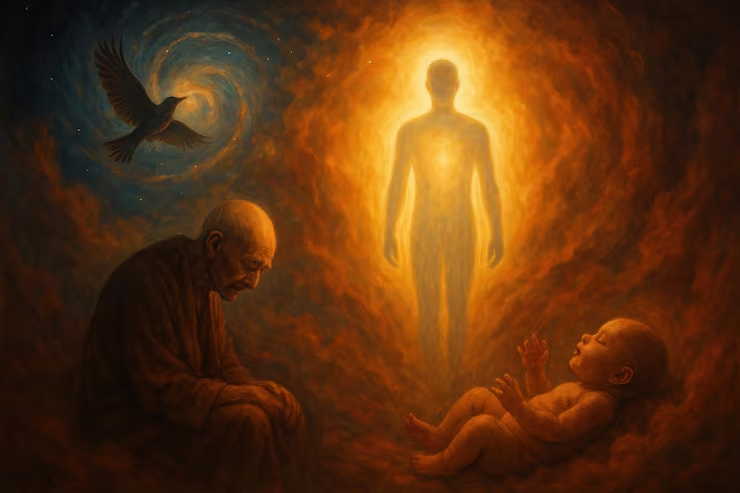
Job 1:21 does not teach reincarnation. Although Job states that he will return naked to his mother’s womb upon death, interpreting this as reincarnation contradicts both biblical theology and basic logic. First, Hebrews 9:27 explicitly states that people are destined to die once and then face judgment, which directly refutes the concept of reincarnation. Second, taking Job’s words literally would imply that he intended to re-enter his own biological mother’s womb. Because Job was old enough to have ten adult children (Job 1:2), his mother would have been either deceased or well past childbearing age.
Similarly, Ecclesiastes 5:15 does not support reincarnation. Written in the context of financial loss and the futility of worldly wealth, the passage notes that a person leaves this world as naked as they arrived, unable to take any material possessions with them. Like Job 1:21, this verse uses poetic imagery to emphasize that humans enter life with nothing and return to the earth at death.
Scripture consistently uses the earth as a metaphor for a “mother’s womb” because humanity originated from the ground. In Genesis 3:19, God tells Adam that because he was taken from the ground, he will eventually return to dust. Psalm 139:15 echoes this metaphor, describing human formation in the womb as being woven together “in the depths of the earth.”
Other passages, such as Psalm 49:17 and 1 Timothy 6:7, reinforce the theme that humans bring nothing into the world and take nothing out of it when they die. Ultimately, both Job 1:21 and Ecclesiastes 5:15 use poetic language to describe returning to the earth—referred to by biblical commentators as the “universal mother” (Jamieson, Fausset, and Brown, Commentary Critical and Explanatory on the Whole Bible, 1998)—rather than teaching reincarnation.