
During the past five years, belief in the prosperity gospel has climbed among Protestant church attendees in the United States. That’s according to a new survey released this week by Lifeway Research.
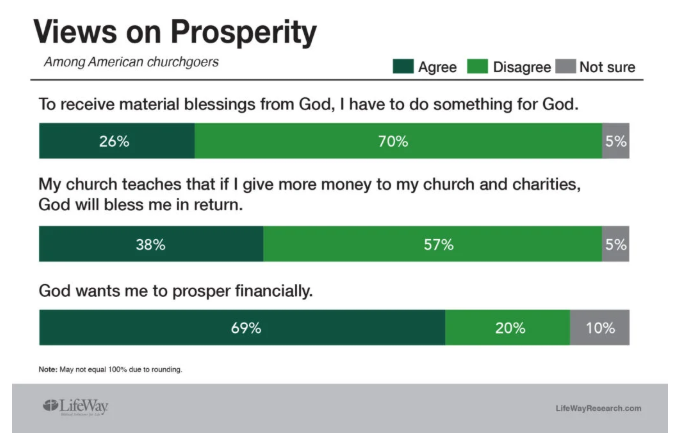
In response to the statement, “God wants me to prosper financially,” 76% of U.S. Protestant churchgoers agreed or strongly agreed. That’s up from 69% five years ago.
In response to the statement, “My church teaches that if I give more money to my church and charities, God will bless me in return,” 52% of U.S. Protestant churchgoers agreed or strongly agreed. That’s up from 38% five years ago.
In response to the statement, “To receive material blessings from God, I have to do something for God,” 45% of U.S. Protestant churchgoers agreed or strongly agreed. That’s up from 26% five years ago.
Lifeway Research conducted its new survey of 1,002 adults last September. The organization’s researchers compared those results to a similar survey they conducted in 2017.
The Prosperity Gospel and Churchgoers’ Changing Beliefs
Scott McConnell, executive director of Lifeway Research, said, “In the last five years, far more churchgoers are reflecting prosperity gospel teachings, including the heretical belief that material blessings are earned from God.”
As for the reason behind the trend, McConnell noted, “It is possible the financial hits people have taken from inflation and the pandemic have triggered feelings of guilt for not serving God more. But Scripture does not teach that kind of direct connection.”
Teachings of the prosperity gospel do not match up with scriptural teachings, said McConnell. “Pursuing holiness was never designed by God to be a plan for financial riches. The size of one’s finances is not the measure of anyone’s service to God nor relationship with him.”
Demographic Breakdown of Lifeway’s Survey
A closer look at the new survey reveals that younger churchgoers are more likely than their older counterparts to adhere to prosperity gospel teachings. That may be because “biblical teachings were poorly heard by more young adults,” McConnell admitted, “but they definitely have experienced a lack of clear biblical teaching on the reason for generosity.”
Although “Scripture teaches God gives good gifts to those he chooses…large numbers of young adults attending church regularly still believe their good deeds can tilt God’s gifts in their direction,” added McConnell.
Less educated churchgoers, those with evangelical beliefs, African American churchgoers, and people who attend church less than four times per month are also more likely to embrace prosperity teachings. Among Protestant denominations, members of Methodist and Restorationist movement churches are more likely to agree with prosperity teachings.
In addition to its faith-related impacts, the prosperity gospel has possible psychological impacts as well. Research shows that it tends to make people more optimistic, happier, and even a little irresponsible with their money.
Responses to Prosperity Gospel Teachings: Diverse and Divisive
Among the demographic nuances, younger churchgoers showed a propensity to align with prosperity gospel philosophies. This preference underscores a broader disconnect with traditional biblical exegesis concerning wealth and giving. Moreover, the doctrines find varying levels of affirmation across educational backgrounds, races, and denominational lines, notably among Methodist and Restorationist churches.
Critique and Concerns: Prosperity Gospel Under Theological Scrutiny
Despite its popularity, prosperity gospel doctrines have faced criticism for deviating from scriptural truths. Lifeway Research’s Scott McConnell sharply refers to them as heretical, arguing that they erroneously equate financial prosperity with spiritual approval. The challenges of recent times, such as economic strain and the pandemic’s aftereffects, may well be factors that intensify the quest for financial security under divine auspices.
Amidst these theological disputes, Bible passages such as 1 Timothy 6:10, which warns that “the love of money is a root of all kinds of evil,” serve as critical reminders of the dangers of wealth idolization. Nonetheless, the prosperity gospel’s allure persists, emphasizing the need for clear and biblically-grounded preaching on God’s view of wealth and prosperity.
Psychological Effects: The Mindset Shift Among Believers
The prosperity gospel’s impacts are not merely spiritual or theological; they extend into the psychological realm as well. Believers enveloped by this doctrine may experience amplified optimism and a misguided sense of happiness tied to material affluence. However, this often comes with the caveat of potential financial irresponsibility, highlighting the complexity of the gospel’s implications on personal stewardship.
As ChurchLeaders’ Content Manager Dale Chamberlain observes, in an effort to avoid prosperity teachings, evangelicals tend to overcorrect by developing a scarcity mindset, viewing suffering as inherently virtuous, underpaying their church leaders, and failing to recognize that God does bless our generosity (though not necessarily in the form of financial returns).