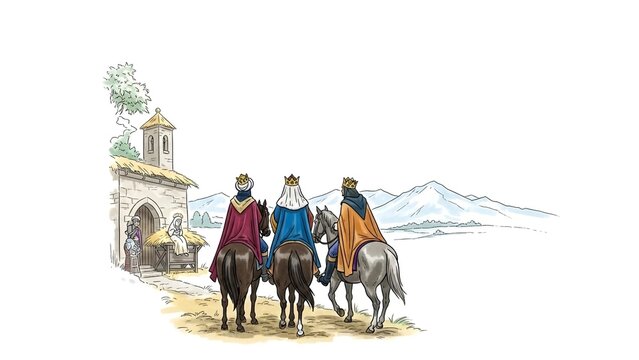
The Magi (often translated as “wise men” or “kings” in later traditions) appear exclusively in the Gospel of Matthew 2:1–12 in the New Testament. The Bible provides no detailed personal history, names, exact number, or backstory for them beyond this passage. Here’s a summary of the scriptural account:
- After Jesus’ birth in Bethlehem during King Herod’s reign, “Magi from the east” arrived in Jerusalem.
- They inquired, “Where is the one who has been born king of the Jews? We saw his star when it rose and have come to worship him” (Matthew 2:2, NIV).
- Herod, disturbed, consulted chief priests and teachers of the law, who cited Micah 5:2 prophesying a ruler from Bethlehem.
- Herod secretly met the Magi, learned the star’s timing, and sent them to Bethlehem, asking them to report back.
- The star guided them to the child (now in a house, not a manger), where they worshiped him and presented gifts: gold, frankincense, and myrrh.
- Warned in a dream not to return to Herod, they departed by another route.
This narrative emphasizes Jesus as the Messiah fulfilling Old Testament prophecies, contrasting Gentile seekers with Jewish leaders’ indifference or hostility.

The names Caspar, Melchior, and Balthazar are not found in the Bible. The biblical account in Matthew 2:1–12 refers to the visitors as “wise men from the East” or “Magi,” but it does not specify their number, names, or royal status. The tradition identifying them as three kings named Caspar, Melchior, and Balthazar developed later, with the names appearing in Christian tradition and liturgical practices, particularly from the seventh century onward.
While the Bible mentions three gifts—gold, frankincense, and myrrh—this has led to the common assumption of three Magi, though the text does not confirm this number. The names themselves are derived from later traditions and manuscripts, such as the Excerpta latina barbari from the 8th century, which recorded names like Bithisarea, Melichior, and Gathaspa, later evolving into the familiar forms. Therefore, while Caspar, Melchior, and Balthazar are widely recognized in Christian culture and venerated as saints in various churches, their names are not biblical.
The First Appearance of the Names Caspar, Melchior, and Balthazar
The names began appearing in Western literature around the 6th to 8th centuries.
- The Excerpta Latina Barbari (c. 500 AD): This is one of the earliest known sources. It is a Latin translation of a Greek chronicle from Alexandria. It refers to the Magi as Bithisarea, Melichior, and Gathaspa (which evolved into Balthazar, Melchior, and Caspar).
- The Ravenna Mosaics (6th Century): In the Basilica of Sant’Apollinare Nuovo in Italy, a famous mosaic depicts the three men wearing Persian dress. Above their heads, the names SCS BALTHASSAR, SCS MELCHIOR, and SCS GASPAR were added (though scholars debate if the names were part of the original mosaic or added during a later restoration).
- The “Collectanea et Flores” (8th Century): Often attributed to the English monk St. Bede the Venerable, this text solidified the descriptions that became standard in Western art: Melchior as an old man, Caspar as a young man, and Balthazar as a middle-aged man with a dark complexion.
Etymology and Meanings
The names were likely chosen to reflect the perceived origins of the Magi as representatives of the known world.
| Name | Linguistic Origin | Traditional Meaning |
| Caspar (or Gaspar) | Persian (Ganzabara) | “Treasurer” or “Keeper of the Treasure” |
| Melchior | Hebrew (Melek-i-Or) | “King of Light” or “My King is Light” |
| Balthazar | Akkadian/Babylonian (Bel-shar-uzur) | “Bel (God) protect the King” |
Historical Background and Identity
The term “Magi” (Greek magoi) derives from Old Persian magus, referring to a hereditary priestly caste among the Medes and Persians, known for astrology, dream interpretation, and religious rituals. Historically, Magi were influential in the Zoroastrian tradition, serving as advisors to kings (e.g., in the Persian Empire). By the 1st century, the term broadly applied to Eastern astrologers or scholars.
Scholars suggest they originated from Persia (modern Iran), Babylon (Iraq), or Arabia. A common view links them to Babylonian or Persian wise men influenced by Jewish exiles like Daniel, who rose to prominence in Babylon (Daniel 2:48) and may have shared messianic prophecies (e.g., Numbers 24:17’s “star” from Jacob). The journey likely covered 800–1,200 miles, taking weeks or months by caravan.
The “star” has prompted theories: a planetary conjunction (e.g., Jupiter-Saturn in 7–6 BC), comet, supernova, or supernatural sign. Gifts were typical royal tributes: gold for kingship, frankincense for divinity/priestly role, myrrh for anointing or burial.
Extra-biblical traditions (not scriptural) later named them (e.g., Caspar, Melchior, Balthazar), specified three (based on gifts), and called them kings (influenced by Psalm 72:10–11). Some apocryphal texts, like the Revelation of the Magi, expand fancifully on their origins, but these lack historical reliability.
Divine Providence in the Story
The narrative highlights God’s sovereign guidance (providence), directing events to fulfill His purposes:
- God used a celestial sign to draw Gentile Magi to worship Jesus, showing the Messiah’s light for all nations (Isaiah 49:6; 60:3).
- Gifts provided financial support for the family’s flight to Egypt (Matthew 2:13–15).
- Dreams warned the Magi and Joseph, protecting Jesus from Herod’s massacre.
- Ironically, pagan astrologers recognized the king while Herod and Jewish leaders did not, illustrating God’s orchestration across cultures.
This aligns with biblical providence: God actively governs history, using natural and supernatural means for redemptive ends.
The Bible offers a concise theological account rather than biographical details, using the Magi to affirm Jesus’ identity and God’s inclusive, providential plan. Later legends enriched the story, but the scriptural focus remains on divine revelation and worship.