Aquinas’ Cosmological Argument for the Existence of God
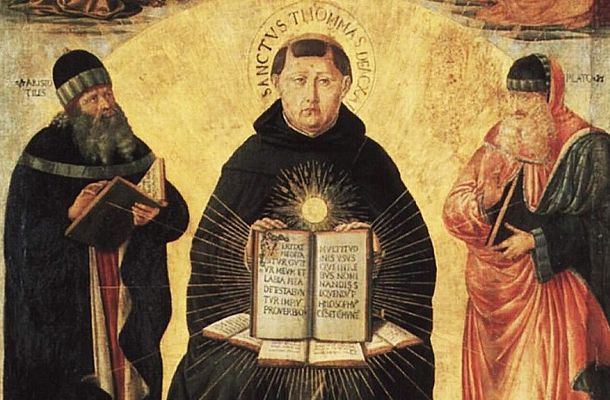
St. Thomas Aquinas (1224-1274) was a Dominican priest, theologian, and philosopher. Called the Doctor Angelicus (the Angelic Doctor,) Aquinas is considered one the greatest Christian philosophers to have ever lived. Two of his most famous works, the Summa Theologiae and the Summa Contra Gentiles, are the finest examples of his work on Christian philosophy.
In his Summa Theologiae Aquinas put forward five proofs (or five ways) for the existence of God:
First Way – Argument from Motion Second Way – Causation of Existence Third Way – Contingent and Necessary Objects Fourth Way – The Argument from Degrees and Perfection Fifth Way – The Argument from Intelligent Design
First Way – The Argument From Motion
St. Thomas Aquinas, studying the works of the Greek philosopher Aristotle, concluded from common observation that an object that is in motion (e.g. the planets, a rolling stone) is put in motion by some other object or force. From this, Aquinas believes that ultimately there must have been an UNMOVED MOVER (GOD) who first put things in motion. Follow the argument this way:
- Nothing can move itself.
- If every object in motion had a mover, then the first object in motion needed a mover.
- Movement cannot go on for infinity.
- This first mover is the Unmoved Mover, called God.
Aquinas is starting from an a posteriori position. For Aquinas motion includes any kind of change e.g. growth. Aquinas argues that the natural condition is for things to be at rest. Something which is moving is therefore unnatural and must have been put into that state by some external supernatural power.
Second Way – Causation of Existence
This Way deals with the issue of existence. Aquinas concluded that common sense observation tells us that no object creates itself. In other words, some previous object had to create it. Aquinas believed that ultimately there must have been an UNCAUSED FIRST CAUSE (GOD) who began the chain of existence for all things. Follow the agrument this way:
- There exists things that are caused (created) by other things.
- Nothing can be the cause of itself (nothing can create itself.)
- There cannot be an endless string of objects causing other objects to exist.
- Therefore, there must be an uncaused first cause called God.
Third Way – Contingent and Necessary Objects
This Way is sometimes referred to as the modal cosmological argument. Modal is a reference to contingency and necessary. This Way defines two types of objects in the universe: contingent beings and necessary beings. A contingent being is an object that cannot exist without a necessary being causing its existence. Aquinas believed that the existence of contingent beings would ultimately necessitate a being which must exist for all of the contingent beings to exist. This being, called a necessary being, is what we call God. Follow the argument this way:
- Contingent beings are caused.
- Not every being can be contingent.
- There must exist a being which is necessary to cause contingent beings.
- This necessary being is God.
Fourth Way – The Argument From Degrees And Perfection
St. Thomas formulated this Way from a very interesting observation about the qualities of things. For example one may say that of two marble sculptures one is more beautiful than the other. So for these two objects, one has a greater degree of beauty than the next. This is referred to as degrees or gradation of a quality. From this fact Aquinas concluded that for any given quality (e.g. goodness, beauty, knowledge) there must be a perfect standard by which all such qualities are measured. These perfections are contained in God.
Fifth Way – The Argument From Intelligent Design
The final Way that St. Thomas Aquinas speaks of has to do with the observable universe and the order of nature. Aquinas states that common sense tells us that the universe works in such a way, that one can conclude that is was designed by an intelligent designer, God. In other words, all physical laws and the order of nature and life were designed and ordered by God, the intelligent designer.