Sola Scriptura: Scripture as the Final Authority
The Core Claim
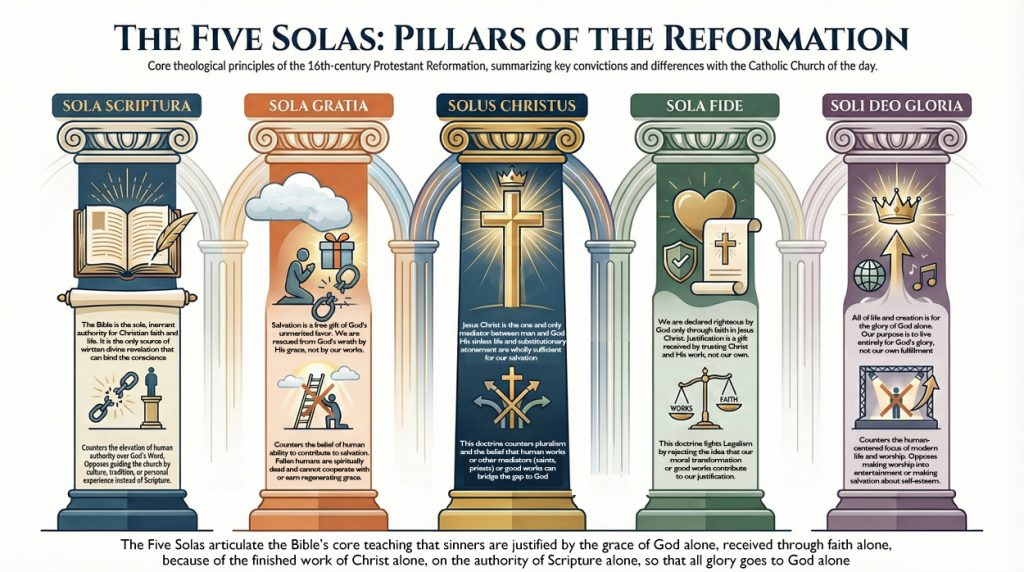
Sola scriptura holds that Scripture alone is the supreme, final authority in all matters of faith and practice. This doesn’t mean the Bible is the only source Christians consult — creeds, councils, church fathers, and traditions all have value — but it does mean Scripture is the ultimate judge over all of them. Everything else is tested against it; nothing stands above it.
How This Differs from Catholic Teaching
Rome teaches that Scripture and Sacred Tradition carry equal authority, with the Church’s Magisterium (its official teaching office) serving as the infallible interpreter of both. The Protestant view says Scripture rules over tradition; the Catholic view says they stand side by side. This is, at bottom, the most fundamental difference between the two traditions — virtually every other disagreement flows from it.
The Biblical Case
Five arguments support the Protestant position:
- Scripture’s completeness — Paul says Scripture fully equips believers for every good work, implying nothing essential is missing (2 Tim. 3:15–17).
- Old Testament pattern — God’s people were consistently measured by what was written, not by priestly or prophetic tradition.
- Jesus and the apostles — Christ settled disputes with “it is written,” and the Bereans were praised for testing everything against Scripture.
- Jesus vs. tradition — Jesus repeatedly subordinated Jewish tradition to the written Word, accusing the Pharisees of using tradition to void Scripture.
- Covenantal finality — Covenants are sealed documents that cannot be added to, which is why Revelation warns against adding to its words (Rev. 22:18–19).
Answering Common Objections
- “No one taught this before Luther.” False. Both Basil of Caesarea and Augustine explicitly placed Scripture above all other authorities, treating it as the sole unerring rule.
- “Protestant divisions prove you need a Magisterium.” Not all divisions are sinful, a shared core of doctrine unites many Protestant churches, and Catholic unity is largely an illusion — deep disagreements exist within Catholicism too.
- “The church is called the pillar of truth (1 Tim. 3:15).” Protestants affirm the church’s vital role, but a supporting pillar is not the foundation. The church applies Scripture; it doesn’t sit above it.
- “The church gave us the canon, so it must be infallible.” The church recognized the canon — it didn’t create it. The apostolic writings imposed their own authority, just as gravity existed before Newton named it.
The Practical Stakes
Denying sola scriptura has consequences. The Catholic Church, despite its reverence for Scripture in theory, has in practice produced a culture where most laypeople are biblically illiterate and most parish teaching is shallow. Even Catholic writers like Peter Kreeft concede that Protestants surpass Catholics in preaching, hymnody, and biblical familiarity. The promise of “more” — more sacraments, more tradition, more authority — has often meant less of what matters most: the Word itself.