God revealed the time, the manner, and even the response to the Messiah’s coming, yet people still did not recognize Him.
1. The Time Was Revealed
God had already revealed the time when the Messiah would come.
A. God Gave a Timeline
Daniel 9:25 (NKJV)
Know therefore and understand, that from the going forth of the command to restore and build Jerusalem until Messiah the Prince, there shall be seven weeks and sixty two weeks; the street shall be built again, and the wall, even in troublesome times.
This was something they could know. That was not just a general statement. God gave them a real starting point something you could point to in history.
B. We Get the Command in Nehemiah
Nehemiah 2:5–6 (NKJV)
“And I said to the king, ‘If it pleases the king, and if your servant has found favor in your sight, I ask that you send me to Judah, to the city of my fathers’ tombs, that I may rebuild it.’ Then the king said to me, ‘How long will your journey be? And when will you return?’ So it pleased the king to send me; and I set him a time.”
We also know what date this is…
Nehemiah 2:1 (NKJV)
“And it came to pass in the month of Nisan, in the twentieth year of King Artaxerxes, when wine was before him, that I took the wine and gave it to the king. Now I had never been sad in his presence before.”
This date is historically identified as March 14, 445 BC.
C. Understanding the Weeks
Before we can do the math, we have to understand what the word “weeks” actually means in Daniel 9. In the original Hebrew, the word translated “weeks” is shabua (שבוע). It simply means a “seven” – a group of seven. Just as our English word “dozen” means twelve things, shabua means seven things. The text does not say seven days. It says a “seven,” and the context tells us what kind.
Where Does the “Weeks of Years” Idea Come From?
This is not a modern invention. The understanding that a prophetic “week” equals seven years goes back centuries in Jewish and early Christian scholarship.
Jewish tradition itself taught that just as there is a week of days (Sabbath cycle), there is a week of years – a shemitah cycle. Every seventh year in Israel was a Sabbath year for the land (Leviticus 25:1–4). This concept of a “year-week” was deeply embedded in Hebrew thought.
Early church fathers, including Julius Africanus (writing around AD 221), were among the first to apply the “weeks of years” interpretation to Daniel 9 and attempt to calculate when the Messiah would appear. He noted that 69 weeks of years from the decree would bring the prophecy to the time of Christ.
But the scholar who worked out the calculation in its most precise and famous form was Sir Robert Anderson, a Scottish-born detective and head of Scotland Yard’s Criminal Investigation Department, in his 1894 book The Coming Prince.
Anderson a trained investigator. Approached Daniel 9 the way a detective approaches evidence: systematically, mathematically, without assuming the answer. What he found astonished him.

Sir Robert Anderson (1841–1918) was a distinguished Scotland Yard official who served as the second Assistant Commissioner (Crime) of the London Metropolitan Police from 1888 to 1901, notably directing the investigation into the Jack the Ripper murders.
Beyond his law enforcement career, Anderson was a prominent lay theologian and writer known for his work in biblical prophecy and apologetics, particularly his book The Coming Prince, which argued that Jesus Christ’s Triumphal Entry fulfilled the prophecy of Daniel 9:24.
The Coming Prince, written before Israel became a nation again, methodically lays out the prophecies leading to the End Times. This is a classic study of the prophet Daniel and the prophecies given to him. Read a digital version here: https://tinyurl.com/2teku9zk
The Calculation: Here is how it works:
Step 1: Count the weeks.
Daniel 9:25 says 7 weeks + 62 weeks = 69 weeks until the Messiah.
The 70th week is separate.
So we work with 69 shabua — 69 “sevens of years.”
Step 2: Convert to years. 69 × 7 = 483 years.
Step 3: Use the prophetic calendar.
The Bible consistently uses a calendar of 360 days per year – twelve months of thirty days each. This is seen in Genesis, the Flood account, Revelation, and throughout prophetic literature. So:
483 years × 360 days = 173,880 days.
Step 4: Count from the starting point.
Starting from March 14, 445 BC (the decree of Artaxerxes in Nehemiah 2), and counting forward 173,880 days, adjusting from BC to AD and accounting for the lack of a year zero, Anderson arrived at: April 6, AD 32 – Palm Sunday.
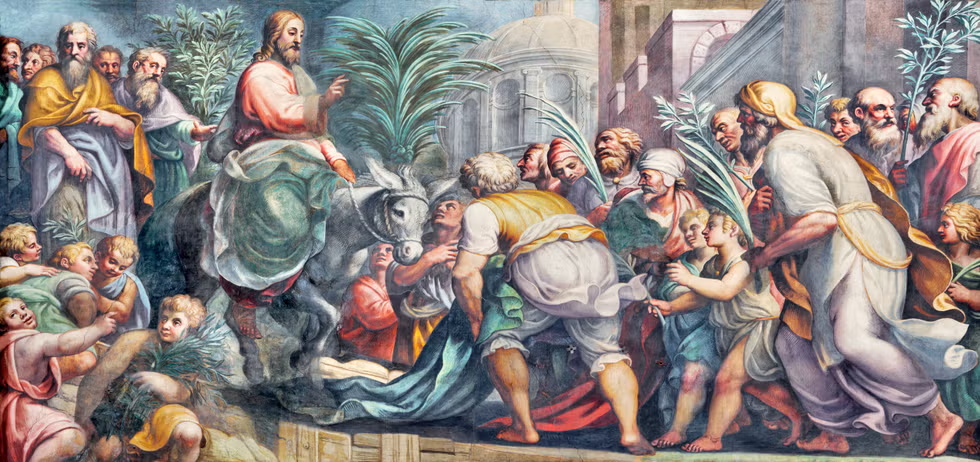
The day Jesus rode into Jerusalem on a donkey, the crowd waving palm branches and crying “Hosanna!” – was the exact day the prophet Daniel had pointed to, more than 500 years earlier.
So, why does the date of Palm Sunday change every year.
The date of Palm Sunday changes every year because it is a moveable feast directly tied to the date of Easter, which is determined by the lunar calendar rather than the fixed Gregorian calendar.
Easter falls on the first Sunday after the first full moon following the spring equinox (specifically, the first full moon on or after March 21), meaning it can occur anytime between March 22 and April 25. Since Palm Sunday is always celebrated exactly one week before Easter, its date shifts annually to align with this lunar-based calculation.
- Earliest possible date: March 15 (when Easter falls on March 22).
- Latest possible date: April 18 (when Easter falls on April 25).
- 2026 Date: March 29.
- 2027 Date: March 21.
If you are interested in a detailed explanation of how Easter Sunday is calculated every year, I have written an extensive article on this: https://mikelilley.com/2025/11/28/determine-the-date-of-easter/