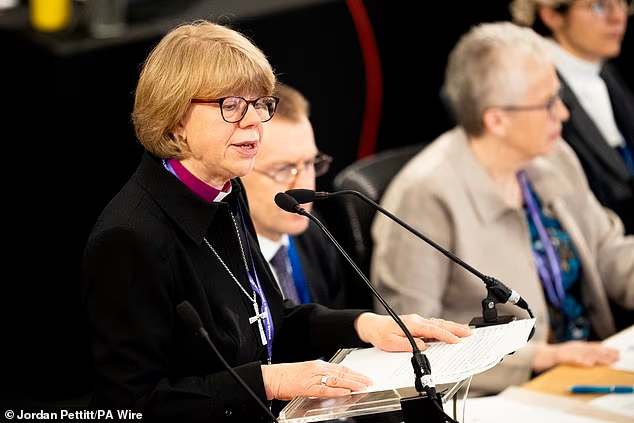
The new Archbishop of Canterbury was today hit with a backlash from churchgoers over plans to spend £100 million on slavery reparations.
Dame Sarah Mullally was accused of helping to “mislead the public” and “putting out the fire with gasoline” by pressing ahead with the plans.
It was also claimed that a report suggesting the Church of England has historical links to the slave trade was “fundamentally flawed”—something it has strongly denied.
The revolt broke out on the fringes of a meeting in Westminster of the General Synod, the Church’s rule-making body and her first as leader.
It comes after a group of Conservative MPs and peers wrote to her last month urging her to scrap the reparations plan, also known as Project Spire, branding it a “legally dubious vanity project.”
Professor Richard Dale, an Emeritus Professor of the University of Southampton and a Fellow of the Royal Historical Society, sat on the panel of the fringe gathering attended by around 100 worshippers this afternoon.
He said: “Up to this point, the Church Commissioners [who commissioned the Project Spire report] and their advisers, faced with evidence of fundamental flaws in their research, have closed ranks, reiterated their ill-founded claims, and refused to engage with their critics.”
He added: “History matters, and what is certain is that such a scheme should not be launched on the back of a false historical narrative… this narrative is demonstrably false.
“The Church Commissioners’ historical advisers have misled the Commissioners, the Commissioners have misled Church leaders, and Church leaders have misled the public at large.
“Because there is incontrovertible evidence that Queen Anne’s Bounty [a Church of England fund established in 1704] investments earned not one penny from the slave trade.
“I don’t think I’ve ever come across such an elementary error with such far-reaching consequences, because this historical falsehood is going around the world.”
He claimed that researchers commissioned by the Church Commissioners, the CofE’s financial arm, had mixed up the South Sea Company and South Sea Annuities when poring over historical financial documents.
The former invested in the slave trade, but most of Queen Anne’s Bounty related to the latter, which did not, he claimed at the fringe meeting.
It also disputes Professor Dale’s assertion that the South Sea Company and South Sea Annuities were mixed up as two separate entities, saying that the annuities it benefited from related to the South Sea Company and that these were different parts of the same organization, which shared staff and operated from the same headquarters in Threadneedle Street, central London.
It said its original research was done by two qualified historians and that the forensic accounting was carried out by specialists Grant Thornton.
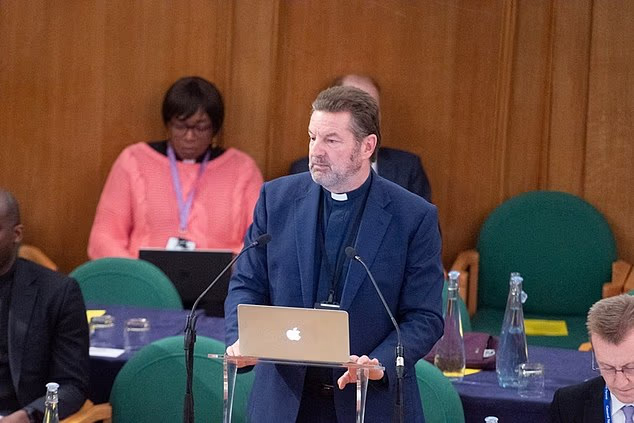
However, the Reverend Professor Lord Biggar, Professor of Moral and Pastoral Theology at the University of Oxford, who also sat on the panel, criticized church leaders for having a “laser focus” on “white oppressors and black victims” because “historically that’s not justified.”
He added: “Why ignore Africans enslaved by other black Africans? Slavery was practiced by every skin color on every continent.”
He claimed church leaders have failed to publish any “carefully worked out justification for the project ethically”—something the Church has denied via its rebuttal on its website.
Fellow panelist Charles Wide KC, a retired Old Bailey judge and former Church treasurer, said the money should instead be spent on supporting parish ministry and maintaining church buildings.
Academic and Cambridge graduate Dr. Alka Sehgal Cuthbert, another panelist, accused church leaders of “putting out the fire with gasoline” because pressing ahead will “encourage segregationist beliefs” based purely on skin color.
Dozens of churchgoers in attendance clapped in agreement with the comments.
The Church of England’s slavery links proposal was announced in January 2023 following the publication of a report into the Church’s historical links to transatlantic slavery.
The report, commissioned by the Church Commissioners, found that the fund established by Queen Anne in 1704 to help poor Anglican clergy was used to finance “great evil.”
It claimed the fund, known as Queen Anne’s Bounty, invested in African chattel enslavement and took donations derived from it.
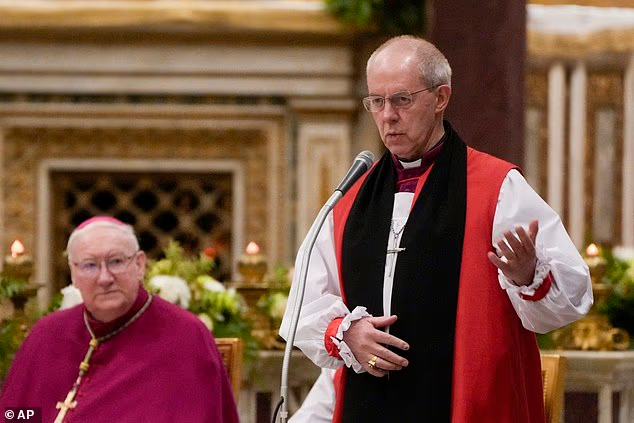
After its publication, then-Archbishop of Canterbury Justin Welby said he was “deeply sorry” for the links and said action would be taken to address the Church’s “shameful past.”
Last month, Dame Sarah said there was a “gospel imperative” to press ahead with spending £100 million of Church money on reparations.
She added that the funds have been set aside as a “repentance” for its investment in slave-trading companies, but insisted it would not divert cash away from parishes, with £1.6 billion already allocated to support local churches over the next three years.
However, several Synod members are known to be opposed, and many worshippers believe the money should instead be spent on supporting parish ministry and maintaining church buildings.