
Is Santa real? Yes, he is, and his true story involves a 4th-century bishop, a 19th-century Anglican, liturgical vestments, and an altercation with a heretic. The true story is so fabulous that only the kids would believe it!
Saint Nicholas to Santa Claus
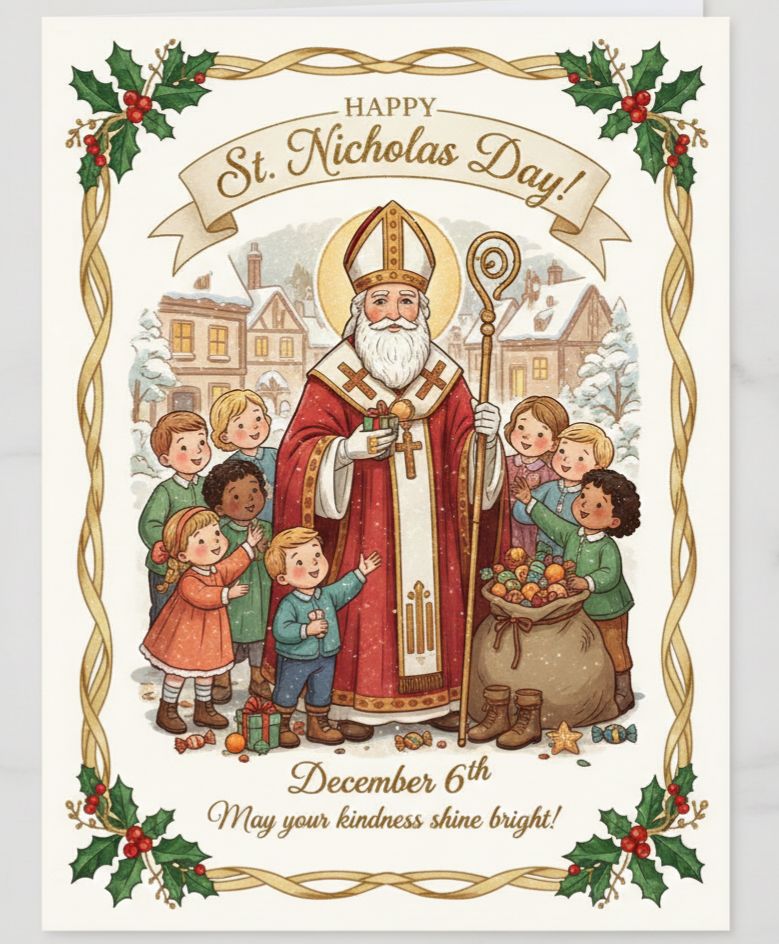
The name Santa Claus is a contraction of the name Saint Nicholas. Nicholas was a fourth-century bishop from Myra, on the Mediterranean coast of modern Turkey.
Saint Nicholas has been celebrated for more than a thousand years. His feast day is December 6th, and since the Middle Ages, many European countries have celebrated the feast by giving gifts. The Dutch, in particular, celebrate Sinterklass, a feast in which Saint Nicholas dons his traditional bishop’s vestments and arrives on a white horse.
The modern celebration of Santa emerged in late 18th and early 19th-century New York, drawing upon the Dutch celebration of Sinterklass and combining it with elements of the English tradition of Father Christmas. Many of the details of the modern Santa were established by the authors of the day, including Washington Irving, and especially Clement Clark Moore, an Anglican professor, in his famous 1823 poem, “The Night Before Christmas.” Moore writes:
‘Twas the night before Christmas, when all through the house
Not a creature was stirring, not even a mouse;
The stockings were hung by the chimney with care,
In hopes that St. Nicholas soon would be there
Bishop Santa
Santa’s appearance is instantly recognizable: red hat, white beard, red cape, white shirt. Many don’t recognize that these are the traditional vestments of a bishop!
The red hat is a bishop’s miter, the white beard is traditional for an eastern bishop, the red cape is a bishop’s chasuble or cope, and the white shirt is an alb or a rochet. The color red is often used for services led by a bishop, especially ordinations and confirmations, and expensive vestments are usually made of velvet, which looks like fur.
And then, of course, there is Santa’s girth. Bishops, too, are often in possession of “a little round belly,” as Moore described Santa in his poem:
Down the chimney St. Nicholas came with a bound.
He was dressed all in fur, from his head to his foot,
And his clothes were all tarnished with ashes and soot;
A bundle of toys he had flung on his back,
And he looked like a pedler just opening his pack.
His eyes—how they twinkled! his dimples, how merry!
His cheeks were like roses, his nose like a cherry!
His droll little mouth was drawn up like a bow,
And the beard on his chin was as white as the snow;
The stump of a pipe he held tight in his teeth,
And the smoke, it encircled his head like a wreath;
He had a broad face and a little round belly
That shook when he laughed, like a bowl full of jelly.
Santa’s Generosity
Saint Nicholas was famous for his generosity, especially to the poor and children. Tradition tells us that he gave dowries to three young girls so that they could marry and would not be forced into prostitution. A later story tells of how he resurrected a group of three children who had been killed and pickled by an evil butcher.
Over time, Saint Nicholas became known as the patron saint of children. These themes were picked up and applied to the modern Santa, who similarly looks out for children, bringing them gifts they want or need. As Gene Autry sings in “Here Comes Santa Claus”:
Here comes Santa Claus, here comes Santa Claus, right down Santa Claus Lane
He’s got a bag that’s filled with toys for boys and girls again
Hear those sleigh bells jingle jangle, oh what a beautiful sight
So jump in bed and cover your head, cause Santa Claus comes tonight
Santa as Defender of the Faith
One of the earliest references to Saint Nicholas is the record of his attendance at the Council of Nicaea in 325. The Council of Nicaea was a monumental gathering in the early church, during which a group of bishops opposed Arius’s teaching that Jesus was not fully divine and not the eternal Son of God. Instead, the bishops affirmed that Jesus Christ is of one being with God the Father and, therefore, fully divine. In the spirit of Santa, I might say that all I want for Christmas is the two natures of Christ: fully human, fully divine!
During the Middle Ages, a legend emerged that Saint Nicholas had personally opposed Arius to the point of losing his temper and slapping Arius in the face. While there is no evidence that this actually happened, the scene is striking to imagine. The story relates that the other bishops temporarily censured Nicholas. They stripped him of his miter until he repented and apologized for his fit of anger. But of course, if there was ever something to get angry about, the heretical denial of Jesus’ divinity is a good cause!
Making A List and Checking it Twice?
The actual heresy in the story of Santa is the idea that he is keeping tabs on children’s behavior. This is not Christianity but rather moralism, and it does not reflect the compassion and grace of Saint Nicholas.
We see this heresy in the song “Santa Claus is Coming To Town.”
He’s making a list and checking it twice,
Gonna find out who’s naughty and nice.
Santa Claus is comin’ to town.He sees you when you’re sleepin’,
He knows when you’re awake,
he knows if you’ve been bad or good,
So be good for goodness sake.
As a Christian, Saint Nicholas knew that all people are naughty, that “all have sinned and fall short of the glory of God” (Romans 3:23). Our righteousness is not a matter of being nice, but rather the righteousness of Christ, which we receive by faith.
And so Saint Nicholas knew that Christian love is generous to children and others. He did so with the full knowledge that they had been bad. Nicholas imitated the love of God, his love for sinners. “God shows his love for us in that while we were still sinners, Christ died for us.” (Romans 5:8).
The true story of Santa is in the Christian response to God’s love: “We love because he first loved us” (1 John 4:19).
https://anglicancompass.com/the-true-story-of-santa-claus

Not Loving Santa
Now, Santa Claus, the guy with the white beard and red suit? I knew all about him! He watched you when you were sleeping (creepy!) and brought you presents on Christmas Eve. He rode in a sleigh with flying reindeer, and you had to leave cookies out for him.
As a child, none of this made any sense to me. I would casually run into “Santa” at the convenience store. He drove an old beat-up Chevy, not a sleigh, and there were no reindeer to be seen! How confusing! He was like the Easter Bunny or the Tooth Fairy, a weird cartoon character that would appear physically in a very cheap-looking costume at the mall or in front of Walmart. And I didn’t know why (I still don’t know why!), you had to dress up every year, go sit in his lap, and have your picture taken.
When I became a mom, I wanted no part in the Santa Claus tradition. My husband and I were going to tell our kids that Santa wasn’t real and leave it at that. I was relieved and excited when I found out that what I knew of Santa Claus was just a cartoon version and that there was a real person underneath, a real person named St. Nicholas.
The Real Saint Nick
St. Nicholas grew up in what is now Turkey. He was born to wealthy parents and, at a young age, gave up his fortune to follow Jesus. He was a devout Christian, dedicating his life to spreading the gospel and helping those in need.
Nicholas became the Bishop of Myra in the 4th century and took part in the great church council of Nicaea that gave us the Nicene Creed—the one we recite every Sunday in church! He was highly concerned with the welfare of the poor and children, and there are many legends about his good deeds.
The traditional story associated with St. Nicholas involves stockings. Legend has it that there was a poor man who had three daughters. The man had no money to get his daughters married, and he was worried about what would happen to them after his death.
Saint Nicholas was passing through town when he heard the villagers talking about the girls, and he wanted to help. He knew that the old man would never accept charity, so he decided to help in secret. He waited until it was night and crept into the house with a bag of gold coins for each girl. While looking for a place to put three bags, he noticed stockings hung over the mantelpiece for drying. He put one bag in each stocking and left. When the girls and their father woke up the following day, they found the bags of gold coins and were able to get married. This led to the custom of children hanging stockings or putting out shoes, eagerly awaiting gifts from St. Nicholas on his feast day, December 6.
Feasting on Cookies
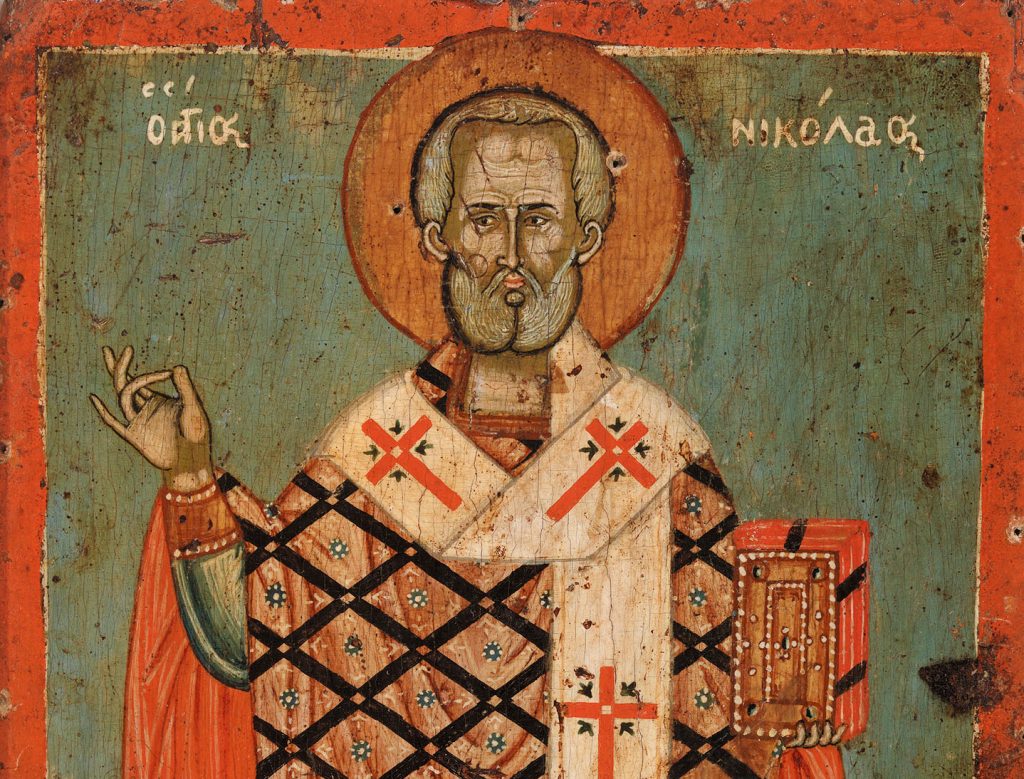
Most of the Christian world still remembers St. Nicholas and celebrates his life on December 6. Christian art usually depicts him as a church bishop with his cope, miter, and crozier. When people dress up as St. Nicholas, they dress like a bishop. When they make cookies on his feast day, the cookies are cut out in the shape of a bishop with a staff. They celebrate his feast day by putting out stockings for St. Nicholas to fill with chocolate candies that look like gold coins and oranges.
On the eve of St. Nicholas, our family made a traditional cookie from western Germany called Speculatius (recipe below). It is a crispy, buttery cookie with lots of cinnamon, and so delicious! We feasted on the cookies before bed and read a sweet board book explaining who St. Nicholas was.
After the children went to bed, my husband and I filled their stockings with little bags of chocolate coins wrapped in gold foil, an orange, and some other fun pieces of chocolate. My children were always so excited when they woke up! They would race to their stockings and eat their candy but never their orange! Before school, we would reread the story of St. Nicholas and pray, thanking God for a man like St. Nicholas, who was willing to give up everything to follow Jesus and dedicated his life to spreading the gospel and caring for those in need.
Looking back, I am so glad we learned about St. Nicholas and that my family celebrated his feast day. Celebrating St. Nicholas Day was such a great way to educate our children on the actual role of St. Nicholas. He dedicated his life to following Jesus. He cared for children and the poor and gave to people who were in need. St. Nicholas would never have wanted to be the focus of Christmas! He would point us all back to Jesus.
How to Make Speculatius
Ingredients
- 1 cup butter
- 1 cup shortening
- 2 cups brown sugar
- 1/2 cup sour cream
- 1/2 teaspoon soda
- 4 teaspoons cinnamon
- 1/2 teaspoon nutmeg
- 1/2 teaspoon cloves
- 4 1/2 cups sifted flour
Directions
- Cream the butter, shortening, and sugar.
- Add sour cream alternately with sifted dry ingredients.
- Knead the dough and shape it into rolls.
- Wrap the rolls in plastic wrap and chill overnight.
- Roll the dough very thin and cut into shapes.
- Bake at 350 degrees for 10 to 15 minutes.