The Bible, particularly the New Testament, demonstrates superior reliability compared to other ancient works when evaluated through the bibliographical test, which assesses the number, age, and accuracy of surviving manuscripts. The New Testament has over 5,800 Greek manuscripts, with some dating within 100 years of the original writings—far earlier than the earliest copies of other classical texts. For example, the earliest known copy of the New Testament, the John Rylands Papyrus, is dated between A.D. 117 and 138, just decades after the original composition. In contrast, the earliest manuscripts of works like Caesar’s Gallic Wars date nearly 1,000 years after the original, and those of Herodotus or Pliny the Elder are over 750 to 1,300 years later.
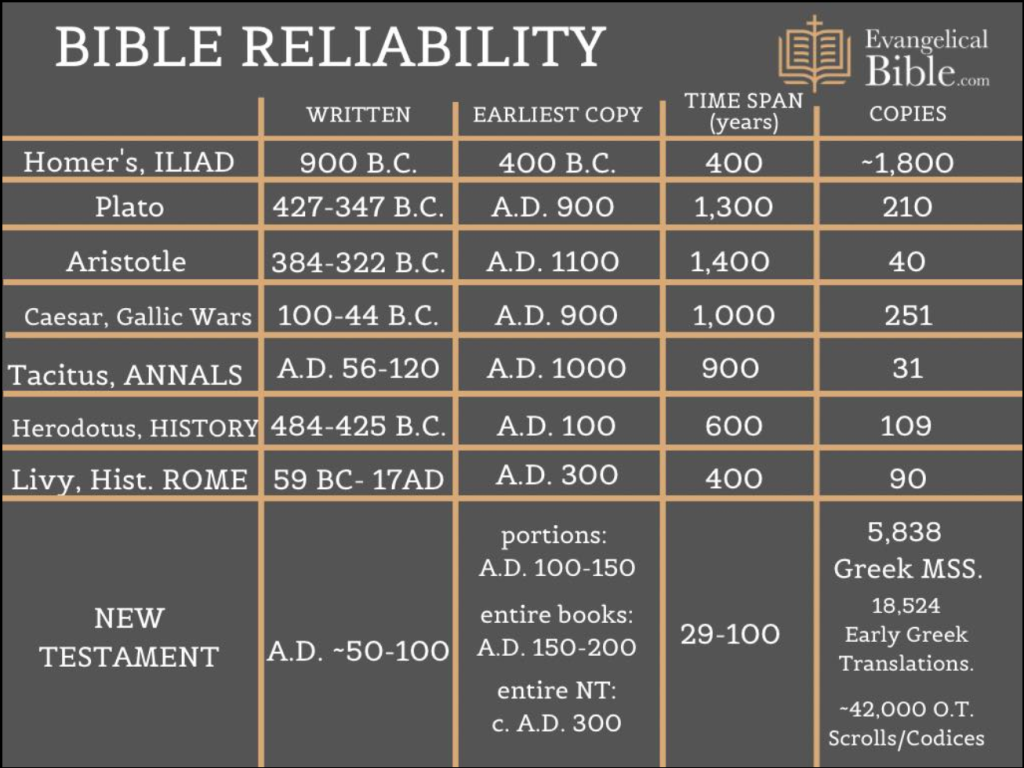
The sheer number of New Testament manuscripts—over 25,000 when including translations and fragments—far exceeds the manuscript evidence for any other ancient text. Even Homer’s Iliad, often considered the best-attested ancient work with around 1,757 manuscripts, has fewer and later copies than the New Testament. The textual stability of the New Testament is exceptionally high, with studies showing over 90% stability from early manuscripts to later Byzantine ones, and only 0.1% to 0.2% of variants affecting the meaning of the text. Scholars estimate that less than half of one percent of the New Testament text remains in doubt, with the vast majority of variants being minor spelling or grammatical differences.
The accuracy of the New Testament text is further supported by the fact that even if no original manuscripts existed, the sheer number of early quotations from the New Testament in the writings of early Church Fathers would allow the entire text to be reconstructed. This level of textual transmission is unmatched; as Sir Frederick Kenyon noted, no other ancient book has such a vast array of early manuscripts and quotations preserving its original reading. In comparison, other ancient works like those of Aristotle, Plato, or Tacitus have far fewer manuscripts, often dating centuries after the original, and are considered reliable despite this gap. The Bible’s reliability is thus not only comparable but superior, especially given its early and abundant manuscript evidence.