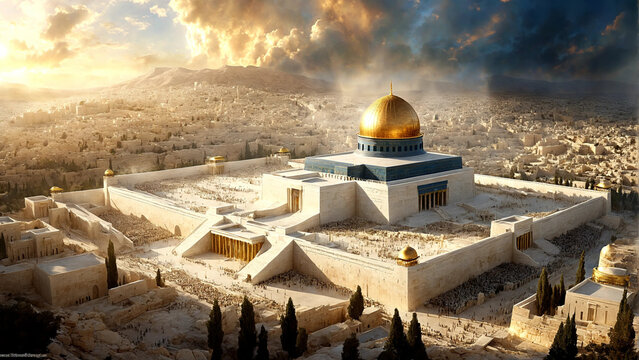
The 3rd Temple – Ezekiel 42-44
1. If Jesus is the third temple, then how could the antichrist desecrate the third temple?
Response:
Jesus identified his body as the true temple (John 2:19–21). After his resurrection, the New Testament applies temple language to the church as his body (1 Cor. 3:16; Eph. 2:21–22). Paul’s warning about the “man of lawlessness” (2 Thess. 2:3–4) is not about a stone building but about a figure who sets himself up within God’s people, corrupting worship and demanding allegiance that belongs to Christ. Desecration is not about bricks being toppled but about idolatry, false teaching, and apostasy within the visible church.
2. Why all the specific dimensions in Ezekiel 40–48 if it’s only symbolic of Christ and the church?
Response:
Ezekiel was given a divine vision not a video blueprint. Prophetic visions often use concrete details to communicate spiritual realities. Ezekiel’s temple is not a construction manual but a symbolic vision of holiness, perfection, and God’s presence among his people. The river flowing from the temple (Ezek. 47) shows this clearly, since no physical temple ever had such a river (nor would some supposed “third temple” built in modern Jerusalem!). The details emphasize order and perfection, pointing to the greater reality fulfilled in Christ and his church. Revelation 21–22 uses similar measurements and imagery for the New Jerusalem, showing us that the true fulfillment is God dwelling with his people forever in Christ.
3. How does the antichrist come into the temple and proclaim he is God? And how do the Gentiles make the temple unclean?
Response:
Paul and John both use temple imagery to describe the life of the church in this age. In 2 Thessalonians 2, the “man of lawlessness” takes his seat in the temple of God, not in a stone sanctuary but within the visible people of God. He desecrates the temple by corrupting worship, opposing Christ, and demanding the honor that belongs to God alone.
Revelation 11 gives us a parallel picture. John measures “the temple of God and the altar and those who worship there” (11:1), a symbolic way of describing the true church, secure in God’s care. But the “outer court,” corresponding to the court of the Gentiles, is given over to the nations, who trample it for 42 months (11:2). This is not about pagans invading Jerusalem’s sanctuary, but about the world’s opposition to the church throughout history.
At the same time, the Lord sends out his witnesses (Rev. 11:3–6), a Moses-like and Elijah-like picture of the Gospel-preaching church. Their prophetic word is powerful, but the world celebrates when they are silenced and martyred (11:7–10). Yet just as Christ was raised, so too his church will be vindicated, raised, and gathered to him (11:11–12).
So, the “desecration” of the temple happens whenever false teaching, persecution, or satanic opposition tramples on God’s people. The Antichrist doesn’t desecrate bricks and mortar but the true temple: Christ’s body, the church. And God promises that though opposed and even martyred, his people will be raised and vindicated when Christ comes again.
4. What about the offerings in that temple?
Response:
All Old Testament sacrifices pointed forward to Christ’s once-for-all offering (Heb. 9:11–14; 10:1–14). With his death and resurrection, the sacrificial system was fulfilled and ended. The “offerings” of the new-covenant temple are no longer animals, but spiritual sacrifices: our praise, thanksgiving, obedience, and lives offered to God (Rom. 12:1; Heb. 13:15–16; 1 Pet. 2:5). Ezekiel’s vision uses sacrificial language to show God’s people as a worshiping community, now fulfilled in Christ’s perfect sacrifice and the church’s ongoing worship.
5. Isn’t this allegorizing the text if we say the temple is Christ and the church?
Response:
This is not allegory but typology. Allegory treats the text as if the details are only symbols that can be reinterpreted at will. Typology recognizes that God himself ordained people, places, and events in the Old Testament to point forward to greater realities in Christ.
The temple is a prime example. The physical sanctuary was real and central in Israel’s history, but it was never the end goal. It was designed by God as a type pointing forward to the Messiah. That is why Jesus could say, “Destroy this temple, and in three days I will raise it up” (John 2:19–21), identifying his body as the true temple. The apostles extend that typology, teaching that the church, united to Christ, is the dwelling place of God (1 Cor. 3:16; Eph. 2:21–22; 1 Pet. 2:5).
Reading Ezekiel’s vision or Paul’s words through the lens of Christ is not allegorizing but honoring the way God structured redemptive history. The old realities were shadows, and Christ is the substance (Col. 2:17; Heb. 8:5; 10:1).
6. Isn’t my body the temple of God?
Response:
Yes, Paul says in 1 Corinthians 6:19 that the believer’s body is a temple of the Holy Spirit. But that is true only because each of us is joined to Christ and made members of his body, the church, which is the primary reality of God’s temple in the New Testament (1 Cor. 3:16; Eph. 2:21–22). We are individually temples only as we share in the one true temple, which is Christ himself and his body.
7. The third temple will be a Jewish temple.
Response:
The New Testament does not point us to a future Jewish temple with sacrifices. Hebrews is clear that Christ’s once-for-all sacrifice has brought the old system to an end (Heb. 10:1–14). Jesus himself is the true temple (John 2:19–21), and in him the church is God’s dwelling place (Eph. 2:21–22). The apostles never tell us to look for another temple in Jerusalem but consistently direct us to Christ and his body. The “third temple” is not a building but Christ himself and his people.