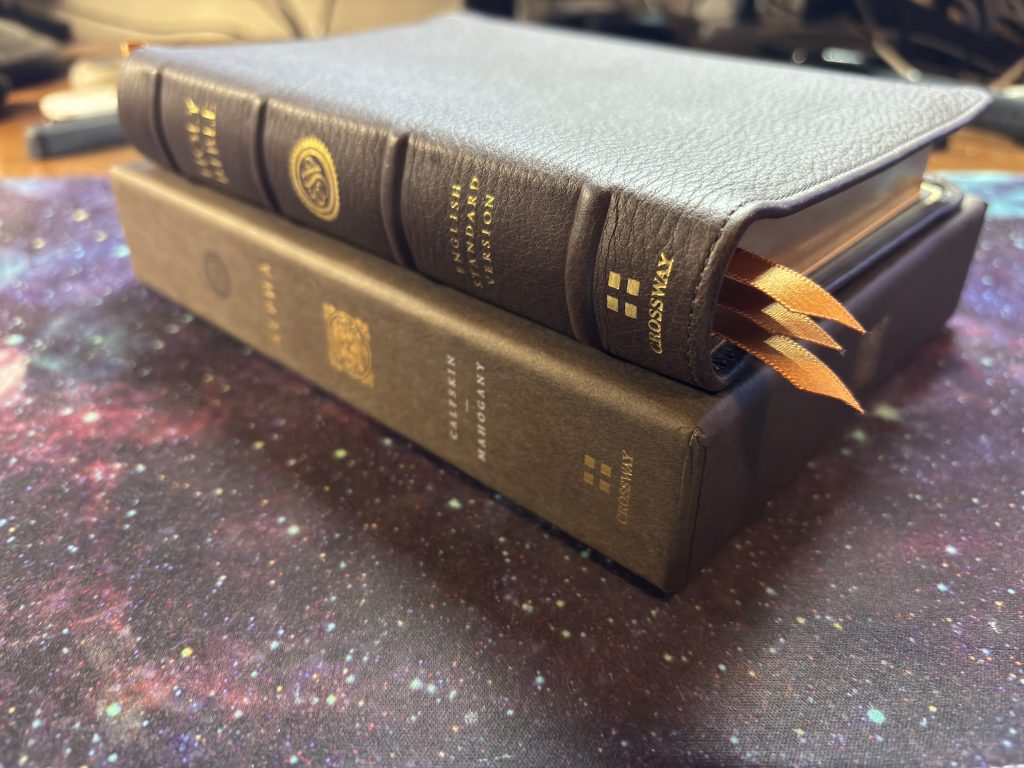
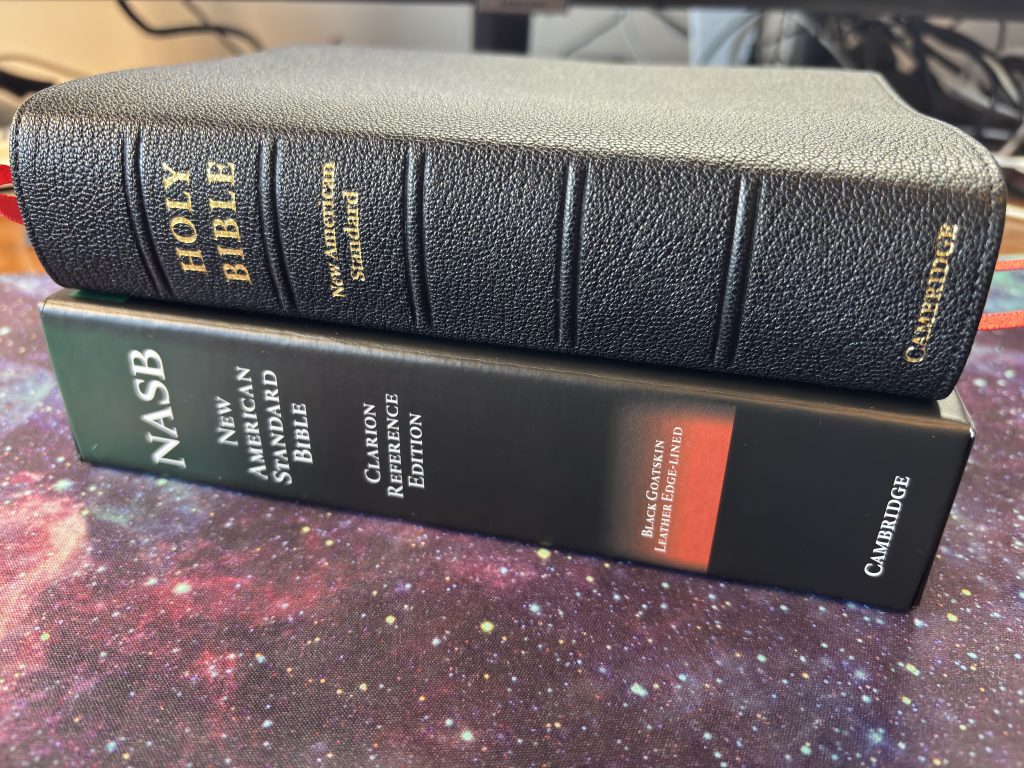
From the best bible reviewer on you tube, IMHO:
From time to time, I’ve been asked to do a video showing how to break in a Bible. Well, this one just came in the mail—it’s a New American Bible Revised Edition. People have wondered if I would do a review of an NABRE. I like the St. Joseph’s edition because it has black-letter text and relatively heavy paper. The print quality is also something I like, so we’ll review this Bible at some point in the future. But all I intend to do today is show you what I do when I break one in.
We’ll get it out of the box. It comes in a nice, heavy two-piece box. As you can see, the pages are sticking together—look at the way those clump together at the edge. So, the first thing to do is start unsticking the pages. Usually, you can do that just by pulling them apart at one end or the other, and they will just fall apart. To help the process, I often do something like that along the corners with my thumb, and that helps break some of them free. With heavy paper like this, you don’t really have to worry about tearing the pages. With some very lightweight—maybe 22 GSM—paper, you have to be very careful.
So, stage one is to pull the pages apart as gently as you can. Separating the pages is a somewhat tedious process. When I do it, I try to let the Bible just relax on its own. I don’t put any pressure on it because I haven’t broken it in yet, and I don’t want to damage the spine. So, I just let it lie as it lies while I separate the pages. We’ll press it out flat in various places as part of the breaking-in process, and I’ll show you the librarian-approved method for doing that.
Sometimes, as you’re separating the pages, you’ll find some that are fairly tightly bound in places, like here. So, I very gently try to separate them in more than two places—try to pry them apart without folding the paper. Sometimes it takes quite a lot of patience. It’s better for it to take a long time than for you to damage or tear the paper in the book itself.
So now the pages are all separated, and we can actually break the book in. What I do is stand the text block up on its spine and press down on the cover on either side to flatten it out. Then, holding the spine—the text block—vertical like this, I take a few pages at a time and press them down on either side. Try to do it evenly, but it’s not always easy to get the exact same number of pages. So, I just attempt to approximate the number on the left, and then on the right, to make it equal.
Sometimes I will switch around like this so that it doesn’t get too monotonous. And then, this way, eventually the book is broken in. Getting close to the end—taking a few sheets at a time. Now, just the way the text block is curving here as you break it in, and how flat these pages are lying now. It will be interesting to see whether it lies flat, or nearly so, in Genesis. Since this is an imitation leather Bible, it may not, but I think we’ll certainly do better than we would have had we not broken it in at all.
So, we’re almost finished. I’m going to do one more pass on this side and then just leave that alone in the center. Let’s see how we do. That feels very flexible. Open it up here—we have a lot of introductory material, but that’s not bad. So, we’re in Genesis 2 here, Genesis 1 on the other end. And here are the maps—the maps are in the middle of the Book of Revelation here. This may take some work; I may need to press this page out away from that map. But it seems to be doing fairly well. Here’s the end of the Book of Revelation, and although it’s not flat, it certainly is lying open.
So, that’s my breaking-in video. Thanks very much for watching. Remember to like and subscribe. Thank you!
Here is another video from a bible re-binder: